The Enemy Never Shows Its Face: “Why we cannot stop telling the Ingalls Little House story”
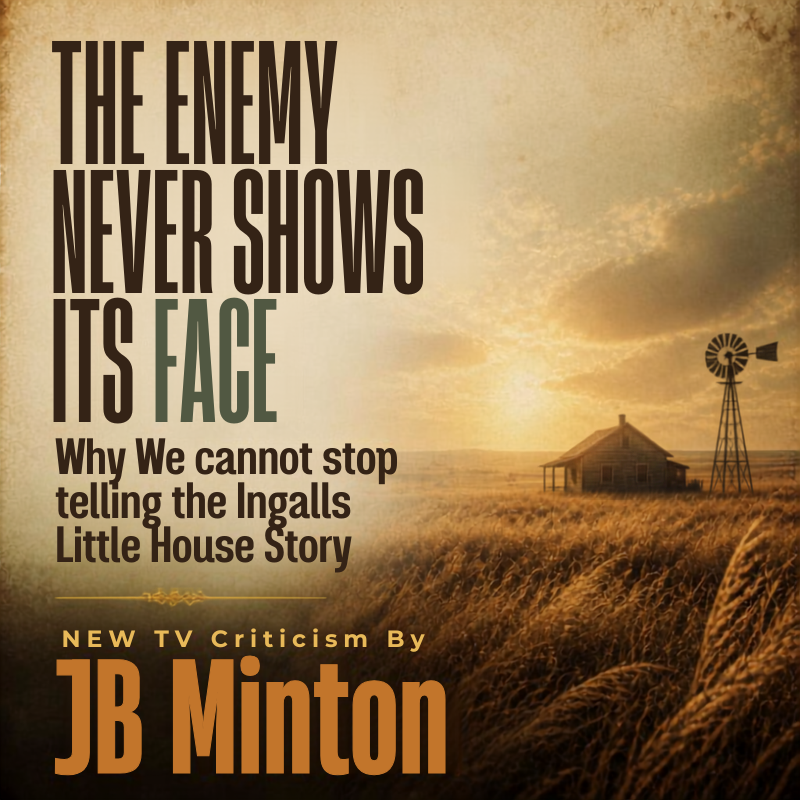
There is a house in the American mind. It has one room, a hearth, and a fiddle hanging on the wall, and it has been under construction for ninety years. Laura Ingalls Wilder framed it in 1932. Michael Landon re-shingled it in 1974. A string of television films patched the roof through the 1980s. And this month, Netflix has thrown the door open again, letting the Kansas wind blow through, letting the Osage stand in the yard, where they always stood in this story, whether or not the camera chose to see them.
We keep building this house. The only question worth asking about any story America refuses to put down is why?
The Gospel According to Half-Pint
Let’s start with what never changes, because the sacred text beneath all the revisions is immutable.
Every version of this story is built on the same four load-bearing beams: love, loyalty, friendship, and a fierce commitment to the local common good. The nine books. The nine seasons of the original series. The television films that trailed after it like mourners. Now the Netflix reimagining. Same beams, every time.
Love, in this saga, is labor. It is Charles Ingalls hauling a plow through unbroken sod because his daughters need to eat, and Caroline stretching cornmeal through a winter that wants her family dead. The books render this love as ritual: the butchering, the sugaring, the fiddle music at night, a liturgy of small acts repeated until they become a life filled with the consistency of love and painful sacrifice. The 1974 series translated that liturgy into the weekly embrace, the tearful reconciliation before the credits. Landon understood television the way a preacher understands a pulpit. You say the same true thing every week until the congregation believes it. The new Netflix series returns love to its original register: quieter, harder-won, shot through with the real possibility of loss.
Loyalty is the second beam, and it is always tested the same way, by distance and by Winter. Pa walks east for work when the grasshoppers take the wheat. Almanzo Wilder drives into a whiteout for seed wheat because a town is starving and someone has to go. The saga’s deepest moral claim is that loyalty is a direction you keep walking when every rational signal says turn back.
Friendship is the beam the adaptations have fought over most. In the books, Laura’s friendships are small and fierce, and her encounters with the Osage are filtered through a settler child’s fear and fascination. The original show gave us the town: Doc Baker, the Olesons, the whole flawed and wonderful congregation of Walnut Grove. Friendship as an ecosystem and the foundation of community. The Netflix series does something braver. It gives Laura a friend named Good Eagle, an Osage girl, and lets that friendship carry the weight of everything the earlier versions could not say. It puts two children from warring cultures on the same prairie and asks the audience to hold the love between them and the merciless machinery of progress grinding toward them both, at the same time, in the same frame.
The fourth beam, commitment to the local common good, is what makes this story American in the oldest and best sense of the word. Barn raisings. Church socials. A town pooling its last dollars. Neighbors showing up to shelter one another from a particular disaster. The true wealth of the Ingalls family is the web of mutual obligations they weave wherever they land. Every adaptation keeps this because cutting it would leave the story’s heart on the table and turn it into yet another cynical tale about pioneers stealing land in America.
The Enemy Is Always Offstage, and Always Enormous
Here is what the comfortable readings of Little House always miss: this is a story about small people being moved around a map by forces that never show their faces.
Read the books again and watch who actually drives the plot. The blizzards are set dressing. Washington drives the plot. The Ingalls family settles in Kansas because the Railroad barons lie and Washington feigns signals that the land will open, but the government pushes these settlers out when it reverses course. The railroad drags Pa west to Silver Lake, sets the towns down like game pieces, and owns the only lifeline when the Long Winter closes its fist. The homestead itself, the dream at the center of everything, is a federal instrument: a bureaucratic wager that a family can be induced to bet five years of its life against a quarter-section of dirt.
The saga’s politics live in this tension. The family and the town are real. The distant powers, the land office, the railroad, the speculators, the paper-shufflers a thousand miles away, are abstractions with the force of weather. Wilder and her daughter Rose, whose libertarian fingerprints are all over the later books, understood something both parties in our current arrangement have spent decades trying to make us forget: the natural unit of American freedom is the neighborhood filled with families who care for one another. The barn-raising radius. The distance a man can walk to help you dig out your well. Every other candidate for that title, the sovereign individual, the benevolent state, gets sold to us daily, and neither one shows up when the well caves in.
The 1974 series kept this spirit but softened its targets, shrinking industrial power to venal bankers and traveling con men, a scale Walnut Grove could defeat in fifty minutes. The television films, by their nature elegiac, mostly mourned what had already been lost. The Netflix series restores the true scale of the antagonist, and then it widens the lens: the same distant machinery crushing the Ingalls’ precarious freedom had already come for the Osage first, and worse. Federal power broke its word to the tribe and dangled the same land before the settlers, and both peoples paid for the same lie in different currencies. That is the story, finally told at full width in this first masterful Netflix season.
Why We Still Need This House
Every generation of Americans rebuilds Little House because every generation needs to relearn the same lesson: freedom is a practice, performed locally, among people who know your name. It cannot be defended from our corrupted capital city, and no one in our capital is even trying to posture this any longer.
The saga endures because it insists, against the grain of nearly every force in modern life, that the human scale is the truest scale. A family, a friendship, a town that shows up for itself can hold against powers that measure people in acres, rail miles, and quarterly returns. It endures because it is honest about the cost: the crops fail, the children die, the government lies (always), the railroad is also Winter. And the story endures because it keeps telling us, version after version, that love, loyalty, friendship, and the common good of the place where you actually live are resistance.
The prairie is different now. The leviathans have new names and better lawyers. But the little house still stands. One room, a hearth, a fiddle on the wall. Every time we tell this story again, we are checking the foundation and finding it still solid
We are going to need it to build what we are about to construct during the next phase of America.
Let’s hope Netflix isn’t stupid enough to cancel this show.