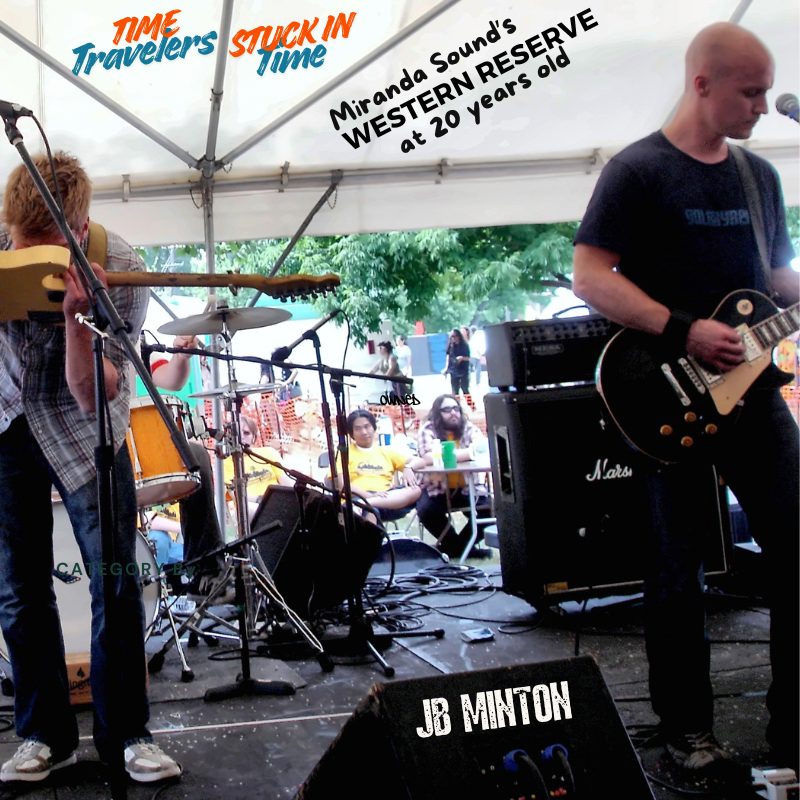
Miranda Sound’s Western Reserve at 20 Years Old: “Time Travelers Stuck In Time”
In 2006, four musicians from Columbus made a record about the pull of home and the cost of leaving it, about a war sold on lies, about warmth that drains away so slowly you never notice it's gone. Twenty years later, Miranda Sound's Western Reserve reads like prophecy. It wasn't foresight. It was precision, a band describing its own time and place so carefully that the description still holds while the world keeps turning.

The Secret History of The Red Room Podcast (2011 - 2022)
Scott Ryan and I built the Red Room Podcast on eleven years of disagreeing in good faith as two nobodies from Ohio with no credentials, arguing about television because we loved it enough to take it seriously. Then Twin Peaks: The Return arrived and did something neither of us expected: it broke the show. This is the story of what a podcast can survive, and what it can't.
Barbarians and Lucid Dying
Two books that have nothing in common turn out to argue the same case: a resuscitation doctor's research into near-death experience, and a surfer's forty-year chase after a wave that never quite let him go. Reading Sam Parnia's Lucid Dying against William Finnegan's Barbarian Days — from a rented apartment above San Francisco's Ocean Beach, burned out on a decade of tech conferences — I found the same lesson twice. Attention, paid all the way to the edge, is the whole technology of living and dying well.
SPRINGSTEEN: Deliver Me From Nowhere (2025)
Springsteen: Deliver Me From Nowhere isn't a comeback story — it's about the damage art does to an artist who isn't yet ready to carry it, and what it takes to stop running and let someone help carry it instead. JB Minton makes the case for a film about men taking care of each other, a father and son measured by a distance no map covers, and a night driven through in the dark until the music itself becomes the light. Watch it once, then watch it again later as a different person — and always put Nebraska back on.
"WE ALL FLOAT...": A Consciousness-Based Appreciation for IT: WELCOME TO DERRY (2025)
Stephen King stopped writing horror after IT — he just didn't tell anyone. This piece reads IT: WELCOME TO DERRY as the belated proof: a town that farms its own children for fear, a general who wants to weaponize a monster's appetite as a unifying national strategy, and a handful of misfit kids who beat both of them the only way any generation ever has — together, by refusing to isolate. Derry is America. Pennywise is the oldest trick there is.
The Seven Sins of Complaining About Artificial Intelligence
Every complaint about AI theft, laziness, or moral collapse turns out, on inspection, to be a complaint about something else — nostalgia for a gatekept industry, status panic dressed up as ethics, labor romanticism for jobs nobody actually wanted. This piece runs the seven excuses down one by one and asks the question underneath all of them: are you protecting humanity, or protecting yourself? Complaining is not a position. It's a delay tactic.
The Enemy Never Shows Its Face: “Why we cannot stop telling the Ingalls Little House story”
Little House on the Prairie was never really about blizzards and bake sales — it's about a family getting moved around a map by forces that never show their faces: the railroad, the land office, a federal government that promised the Osage the same ground it later sold out from under both of them. The 1974 series shrank that villain down to a con man Walnut Grove could beat by dinner; the new Netflix season is the first to tell it at full scale. Freedom, JB argues, was never handed down from the capital. It's practiced locally, by people who know your name.
There Is Only the Doing: “How to find the middle ground between 'AI will save the world' and 'AI will destroy the world"
The argument over whether AI will save the world or destroy it is mostly a way to feel certain about something without doing anything about it — for the people actually building this technology, adoption was never a debate, it was a job requirement. JB argues the real fight isn't over whether to use AI, but over the unglamorous work everyone skips: who owns the data, who gets paid, what guardrails get built before the next wave outruns them. Certainty is cheap. The doing isn't.
Disclosure Day (2026): The Spielberg Film With No Villain
Disclosure Day hands you a cover-up, a company town's worth of secrecy, and a man who spent his life deciding ordinary people couldn't survive the truth — and still refuses you a villain. The only enemy in this film is ignorance, and the only way past it is remembering. This is a reading of Disclosure Day as the closing movement of a cycle Spielberg started fifty years ago at Devil's Tower, and of the moment a woman refuses the role a frightened crowd keeps trying to hand her: "I don't want to be anyone's religion.”
Why Is Everybody So Sick?
Ask someone how they're doing and you'll get a symptom list — that's the culture now, illness as personality, suffering as the only proof anyone's paying attention to their own life. JB Minton spent ten years learning it doesn't have to work that way: stress lives in the body before it's ever a thought, and no amount of thinking gets you out of it. Suffering, he argues, is a mistake — not a life sentence.