Why I’m Writing
The Great American novel
Every other page of my high school yearbook has someone in motion: cleats, costumes, a trophy held up for the camera. Mine has the one photo everyone got, the standard headshot, and nothing else.
I told myself this was fine. I was short, skinny, slow, with no interest in exercise and no illusions about winning anyone over with my height or my muscles. Sports were never really mine to lose. But the clubs were. Nobody kept me out of those. I just had no ambition to spend one more hour at that building than the day required. I had friends I loved, a girlfriend I wanted, and sex I was chasing without losing my soul over it. That felt like the whole curriculum.
Looking at the blank pages now, the idiot wasn't the kid who skipped the woodshop photo. It was the kid who thought love and lust were an education, and the rest was just time served.
I got the bill for that later, with interest. In my twenties, on a path to becoming a doctor, I went through a series of psychedelic experiences that disillusioned me with the life I'd already mapped out. I found my soul. I also disrupted every relationship I had. Walking away from medicine for a mission I couldn't yet name, something I only knew to call enlightenment, was the actual cost of the thing I'd been protecting for free since I was seventeen. Protecting your soul is cheap when the stakes are a club photo. It gets expensive once the stakes are your career and the people who love you.
That's the lesson underneath the novel I'm writing now, and it's the only credential I'd ask you to take on faith: I didn't arrive at this thesis from a chair. I paid for it.
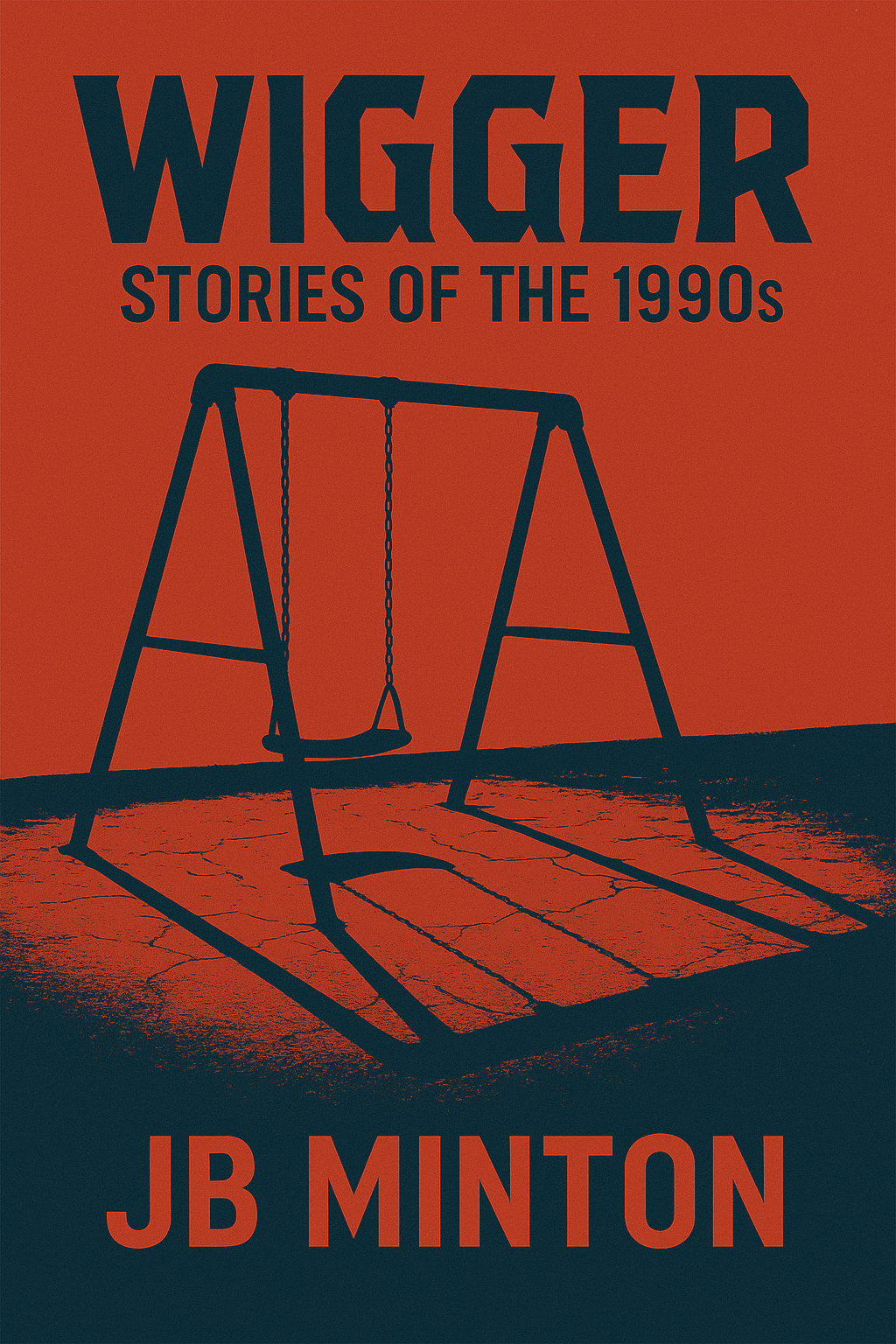
The book is called Wigger: Stories of the 1990s. On the surface it's a collection of interconnected stories set in 1990s Ohio, built around a kid named Wigger and the friend who protects him, Jimmy Prince. Underneath, it's a novel wearing a story collection's clothes. Each story is a spoke. They all lead to a hub revealed only in the last one, a single night of violence that the rest of the book has been circling without naming. Details planted early, a doctor's vocational drift, a card game funding tuition, a friend's no-questions-asked ride, detonate retroactively once you see what they were always pointing toward. It's a story too full to tell straight through, which is exactly why it isn't.
The thesis running underneath all of it: empathy alone isn't enough, and action alone curdles into violence. Only the pairing, feeling something and then doing something about it, produces anything redemptive. The book doesn't argue this. It makes you watch what happens to people who have one half without the other.
If you ever lived under a label, jock, nerd, theater geek, the kid who got through the day by burying what hurt, this book isn't nostalgia about that label. It's an argument that the label was never the whole story, and that whatever you did with what was underneath it mattered more than the label ever did.
Most coming-of-age stories about the nineties settle for the soundtrack and the costumes. This one is trying to earn its stakes the way the decade actually earned them, through Kings Island, basement card games, the Odie Tap, and the particular violence of growing up watched but not seen. That's slower to build than nostalgia, and it doesn't come with shortcuts. I'm building it the long way, as an independent author and publisher, one story at a time.