Barbarians and Lucid Dying
Two books that have nothing in common turn out to argue the same case: a resuscitation doctor's research into near-death experience, and a surfer's forty-year chase after a wave that never quite let him go. Reading Sam Parnia's Lucid Dying against William Finnegan's Barbarian Days — from a rented apartment above San Francisco's Ocean Beach, burned out on a decade of tech conferences — I found the same lesson twice. Attention, paid all the way to the edge, is the whole technology of living and dying well.

"WE ALL FLOAT...": A Consciousness-Based Appreciation for IT: WELCOME TO DERRY (2025)
Stephen King stopped writing horror after IT — he just didn't tell anyone. This piece reads IT: WELCOME TO DERRY as the belated proof: a town that farms its own children for fear, a general who wants to weaponize a monster's appetite as a unifying national strategy, and a handful of misfit kids who beat both of them the only way any generation ever has — together, by refusing to isolate. Derry is America. Pennywise is the oldest trick there is.
Why Is Everybody So Sick?
Ask someone how they're doing and you'll get a symptom list — that's the culture now, illness as personality, suffering as the only proof anyone's paying attention to their own life. JB Minton spent ten years learning it doesn't have to work that way: stress lives in the body before it's ever a thought, and no amount of thinking gets you out of it. Suffering, he argues, is a mistake — not a life sentence.
Life is Fate and Chance Is Choice
Joseph Campbell called it the hand of a supreme author — the sense, looking back, that a life's chance meetings were written for us. JB Minton's argument here is more exacting than that: fate is the door appearing, and choice is which of us walks through it, one decision compounding into the next until it looks, in hindsight, like destiny. The proof text is R.E.M. drummer Bill Berry, felled onstage in Switzerland by a brain aneurysm in 1995 and saved by a hospital two miles away that happened to hold the one surgeon on earth built for that exact injury — fate, and then, choice after choice, survival.
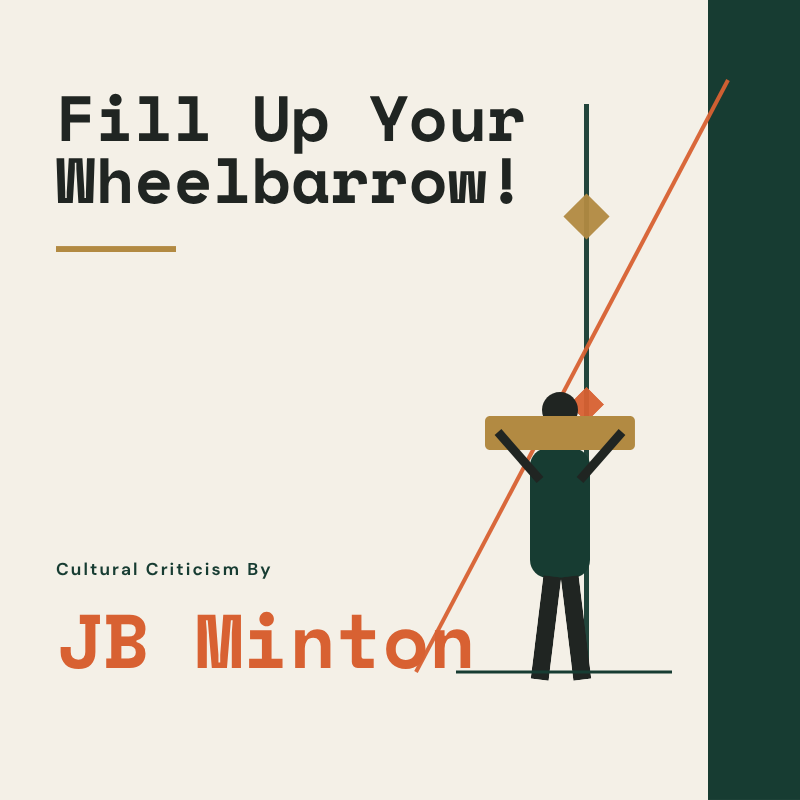
Fill Up Your Wheelbarrow!
The wheelbarrow is your life, the pebbles are everything the world throws at you, and the hill doesn't get gentler because you're tired. JB Minton's parable is blunt about what happens if you never stop to empty the barrow — it's not metaphorical exhaustion, it's the depression, the addiction, the divorce, the disease that pressure left unmanaged actually produces. His prescription is equally blunt: meditate twenty minutes, twice a day, on purpose, or keep pushing uphill until you tip.