Part One: “Someone Had To Lick The Boobies”
In the latter 20th Century, if you wanted the culture to feel your art, then you had to make a movie, a hit song, or a smash record. When it came to stories, novels weren’t as popular or as easy to engage with, and if a book were good enough, someone would make a movie out of it with a killer soundtrack. The world changed after the release of Jaws and Star Wars in the 1970s. Movies were hyper-life to the most popular film critics of our youth, Gene Siskel and Roger Ebert. You can feel their love and passion for cinema when you rewatch their old shows and hear it in the way they banter and go after each other on camera.
Siskel was a stick in the mud, and Ebert was a fussy know-it-all. Ebert was the better writer because he wrote from his heart, but Siskel wrote from a spreadsheet in his mind, using the ink of synovial brain fluid. His opinions were mainly biting, concise, and justified by cynicism, while Ebert’s assessments were often dreamy and soft.
I always preferred Ebert’s reviews over Siskel’s.
For more than ten years, the Red Room Podcast worked for the people who loved TV enough to listen to two no-name, overeducated, middle-aged men suffering from a child’s devotional love of television so deep we had to talk about it and share it with other people, such as we were.
This is a story of creativity and taking chances. There are no villains, only artists who got into a vehicle with two steering wheels and eventually started driving off in different directions. It’s a good story, and I’d like to introduce you to a revisiting of the moments that made the Red Room Podcast, and the story of two boobs that begins with a story about boobies.
“Talk Hard” (1989–2004)
It was my daughter’s third birthday party. She had a Barbie cake complete with a little doll as the centerpiece, naked except for frosting. After my child blew out the candles, my wife pulled the doll from the frosting and held it up for the crowd of friends and relatives to see. All of a sudden, my sister-in-law uncharacteristically yelled out loud to everyone, “SCOTT WILL LICK THE BOOBIES!”
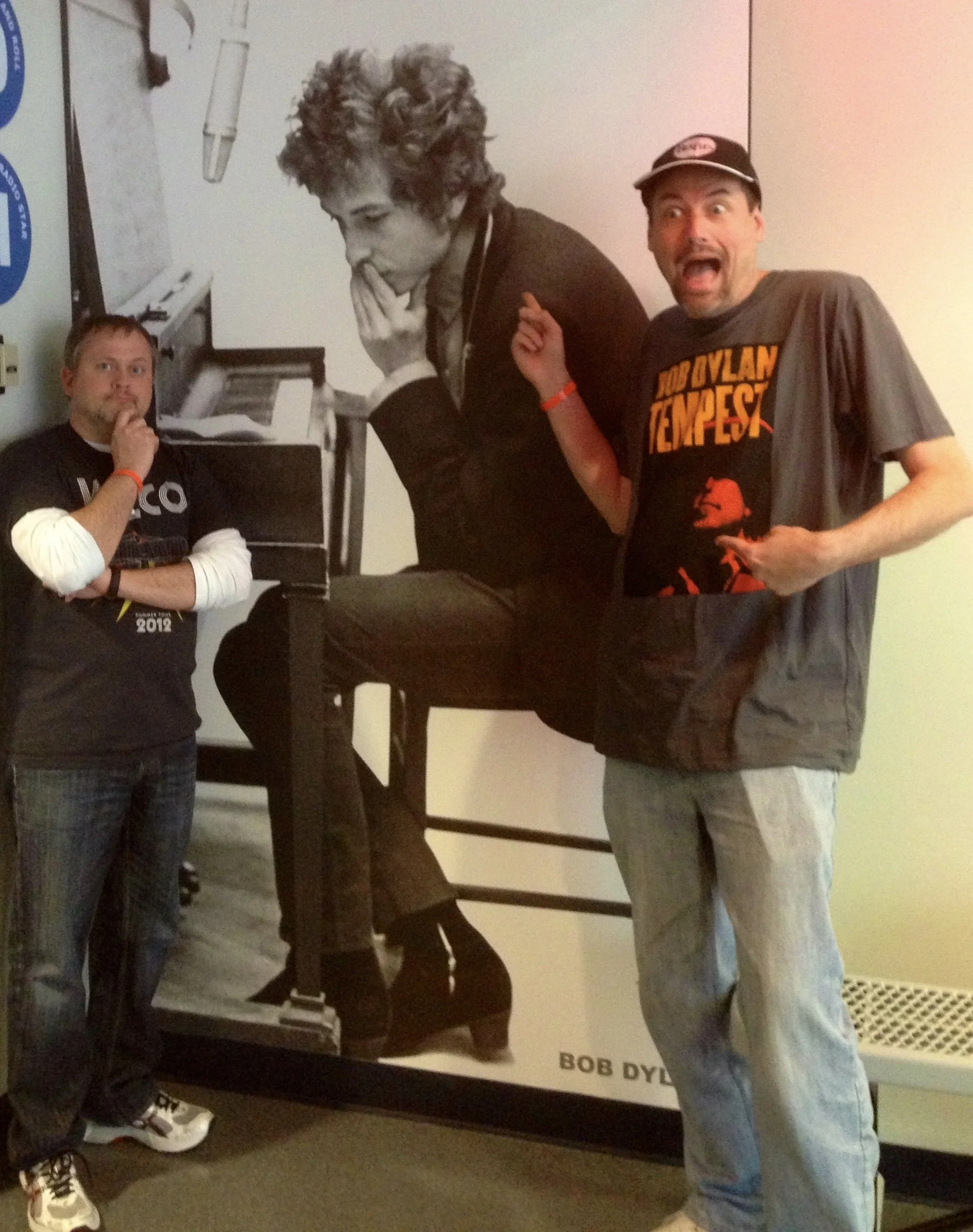
Everyone turned to look at her and the strange, tall, thin man standing beside her. Scott’s eyes went wide for a second, and, sensing everyone suddenly paying attention to him, something took over, and he performed for the gathered audience. Everyone laughed, including me. I thought, “This guy is funny.” After talking to him during the party, I thought, “He’s also smart.” Scott Ryan thinks on his feet and improvises. He was entertaining, he had substance, and he loved popular television as I did. Scott and I always have something to discuss when it comes to TV. We agree on a few things and disagree on everything else. We both think the other one is an idiot about a few key things that matter to no one else. But in the end, Scott and I could always agree to disagree in good faith. The legacy of the Red Room Podcast supports this.
Long Live Happy Harry Hard On!
Twenty-two years before the Red Room Podcast was created, a movie called Pump Up The Volume started the podcast revolution. In this film, Christian Slater played a troubled teenager who set up an illegal pirate radio station in his suburban home after his parents moved him, against his will, from his last home to a new plastic suburb where teen troubles were paved over and ignored because no one cared about the kids who had never been alright. This was before we had heard of the term Generation X, and not long before we would become the wandering generation, searching for a collective identity that we would never fully discover.
The radio broadcast was illegal in the movie because radio transmissions were controlled by Federal regulations and enforced by the threat of a fine or imprisonment. The film ends with Slater’s character being arrested by the fascist federal agents. As he’s taken into custody in front of a crowd of his peers, he yells two inspirational words to his opaque audience: “TALK HARD!” The final sounds of the movie are new teenage pirate radio stations springing up all over the country. The film concluded that, in the future, everyone will have a voice and an audience, and freedom of expression that will one day be untouchable by regulation and law enforcement. This movie predicted podcasting before any teenager had heard the word “Internet.”
The reality of podcasting, the Internet, and social media would be very different than a global village of wise people sharing the best ideas and moving society progressively forward toward equality of opportunity for all. Like all forms of institutional entertainment, the movies and TV shows we consume serve as vehicles for commercial marketing and identity formation, facilitated by the manipulative forces of cultural hegemony. This stuff has always fascinated me because I understand that I’m being manipulated, but the entertainment has always been worth it for me.
The best stories are the ones we willingly go along with to discover depths beyond our egos. The best art properly inspires transcendence beyond our fragile and fleeting identities. This is what we name Proper Art, and I believe that there are plenty of examples of commercial art worthy of discussing transcendent qualities.
“Talking hard” may very well upend our Democracy by polluting the world with angry noise instead of saving it through intelligent ideas projected through art protected by the freest speech in a radio-free America. But I’m getting ahead of myself.
The year was 2000.
A Short History Of Podcasting
A technologist named Dave Winer found a way to enclose a sound file in a digital feed that would automatically download to a user’s computer when they “subscribed” to updates from that feed. On-demand audio distribution was now a reality. In the world before podcasts, radio programs were broadcast at a fixed time, and if you missed it, you'd better hope your friend had taped it on a boombox with a cassette recorder. Around the same time, other technologists developed web applications that aggregated and managed these feed subscriptions into a standard format, complete with play buttons.
Generation X may not have understood what an RSS feed meant, but we damn sure knew how to click a play button, and we clicked the shit out of buttons for years before the term “Podcasting” was coined in 2004 by some nerd. However, the defining moment for these pirate internet radio shows came when Apple integrated podcast support into iTunes, allowing podcast listeners to index millions of feeds and download these internet shows directly to iPods and eventually iPhones. iTunes provided a user-friendly front end that abstracted away the complexity of podcasting technology, bringing simplicity and consistency to the user experience.
Podcasts were fun, popular, and here to stay.
“Twin Peaks? I never watched it.”
Scott Ryan performed his Lick The Boobies improv routine live in my home in the Summer of 2009, just before the Lehman Brothers collapsed and nearly plunged the global economy into a depression. No man was better emotionally prepared to live during a depression than Scott Ryan. We have never seen the world the same way. He’s a cynic, and I’m hopeful. I have faith, and he is faithless. I am dedicated to self-improvement, and Scott mines his life for failures to turn into funny stories. We are nothing alike, but he and I could always keep up with each other about television. We found a place to talk about important themes and concepts of living as conscientious human beings in a morally decrepit world overfilled with noisy entertainment and a little bit of art.
The bedrock of our partnership was rooted in the following American commercial art:
Star Trek
Seinfeld
Curb Your Enthusiasm
The X-Files
Quentin Tarantino’s movies
Bob Dylan’s music (especially his new Century trilogy)
Fiona Apple
Ronald Moore’s Battlestar Galactica
While my passion and scope of love for these shows and films matched Scott’s, I disappointed him in our first conversation. Other than Dune, I had never seen a David Lynch movie, nor did I know who Lynch was or what he was about. Worst of all, to Scott, I had never seen Twin Peaks, a phenomenon that completely passed me by in the early 1990s, and Scott seemed baffled. In the introduction to the First Edition of my book A Skeleton Key To Twin Peaks, Scott recalls it this way:
When we met in 2009, we immediately bonded over our love for television. Best Star Trek? The Next Generation. Check. Best version of Larry David? Curb Your Enthusiasm. Check. And you love Twin Peaks? Twin… what? Somewhere a cherry pie hit the floor.
I am not a judgmental person. I accept everyone. But how could someone claim to be an actual television connoisseur and never have seen Twin Peaks? There are some things I can’t accept.
“Introduction” - A Skeleton Key To Twin Peaks by JB Minton, First Edition (2019)
And so, at Scott’s request, the four of us (he and I, along with our wives) began meeting at my house every Thursday at 8 PM. We called it “TV Night.” We watched two episodes of the same show or one episode each of two different shows. Over the next two years, we would gather and watch the following television:
Twin Peaks Seasons 1-2, & the movie Fire Walk With Me
Battlestar Galactica(Ronald D. Moore’s) - entire show
The Sopranos Seasons 1 & 2
Boston Legal - entire show
Pushing Up Daisies - entire show
Separately, we watched The Wire, Downton Abbey, and a few other shows. Eventually, we published Red Room podcast episodes about these shows as we watched them.
Scott has written, directed, produced, and distributed several independent films, in addition to his work on oral histories and a single volume of criticism, which I find the most compelling of his written works. But at heart, Scott is a visual storyteller. In those days, he deployed a nettlesome habit of pressuring friends, coworkers, and acquaintances to star in his productions, which began during the videotape era and continued through the digital revolution, where images and sounds were captured on computer chips. Scott had an ancient computer he called “Old Bessy,” and his video-editing software came from an era when he ran a small business making movies for weddings, parties, and similar events. One of Scott’s movies will become an important part of our podcast story.
In those early days, he managed to rope my wife and me into playing bit parts in one of his latest “Curb” episodes. He wrote and filmed entirely original scripts but stayed true to Larry David’s Curb Your Enthusiasm format. They were quite amusing for amateur work, and being part of something creative was enjoyable, akin to community theater.
Scott spent a lot of his time engaged in non-commercial creative pursuits outside his work in a corporate call center, which slowly eroded his spirit a little more every day. I think his gonzo art projects were a way to remind him he was alive and to remind everyone around him that they were alive too. I used to enjoy this spirit of the artist in Scott. It helped reawaken the artist in me.
Scott preferred his view of the world over anyone else’s, and he has always expected the world to participate in the plays he puts on. And like his reaction to “Scott will lick the boobies,” he is always ready to act in whatever spotlight he finds himself standing inside. Speaking from experience, if you’re creating a podcast, you want a person like this as your partner.
As for me, I was happy to be talking about television with someone who could keep up with me. Throughout my life, I’ve sought out people who can match my energy in intellectual and moral discussions about popular art, and for a few years, I found someone who could.
Josh: “You Should Create a podcast”
Scott: “What’s a podcast?”
I don’t remember how the first conversation Scott and I had about podcasting started. But I remember he understood me when I told him, “They are internet radio shows that people online subscribe to and listen to on their iPods” (iPhones were just getting started, and I didn’t have one back then).
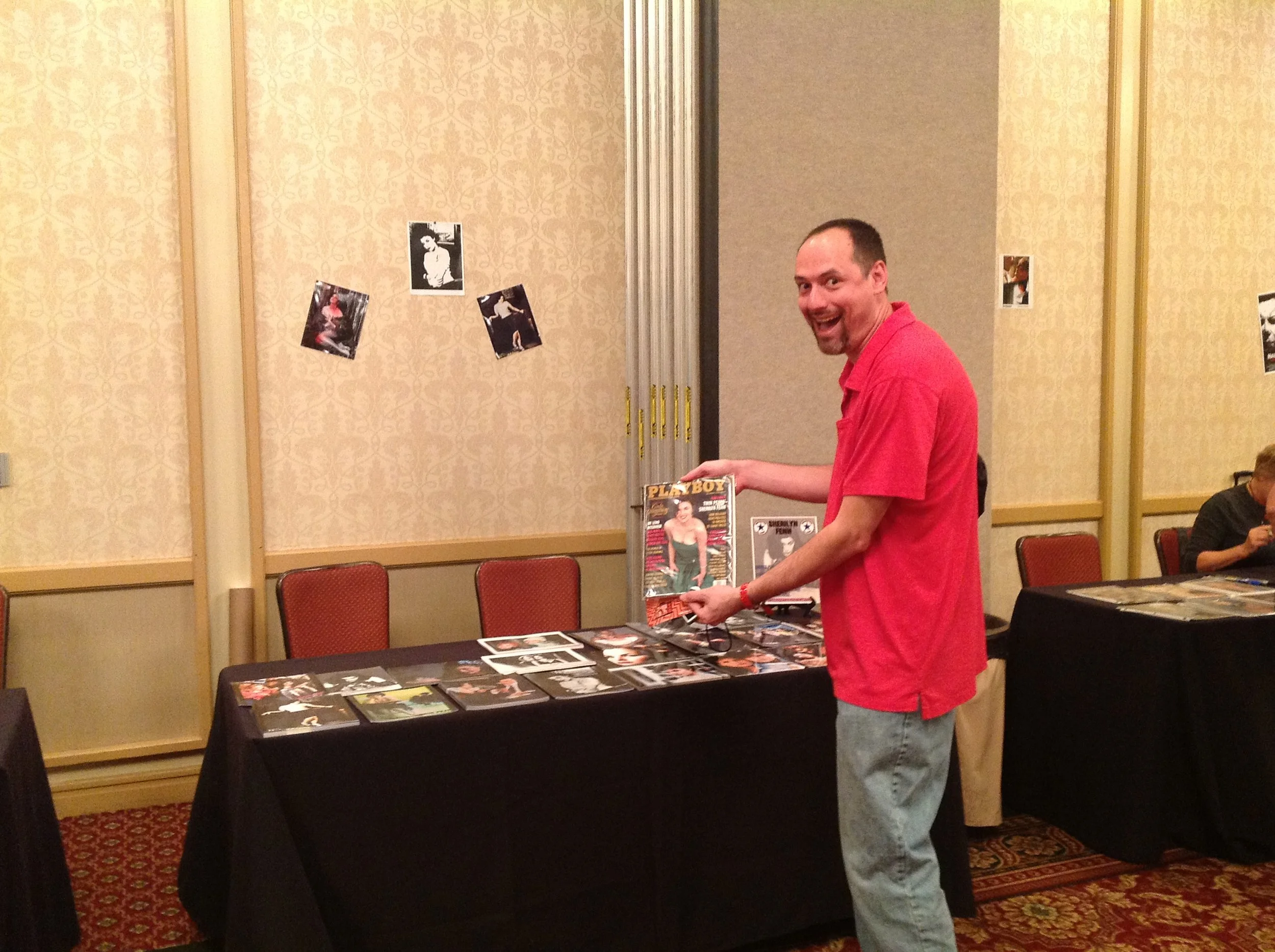
I quickly learned that Scott was a Luddite when it came to technology. But I also learned that while he knew how to use computers and the Internet, he is a person who accepts change like an old man wiping around a new hemorrhoid. But I also suspected that he would quickly adapt to the podcasting process. I had no idea how obsessed Scott would become with podcasting over the first few years of the Red Room Podcast, but in retrospect, I’d recommend obsession and discipline over talent any day. But when you combine all three qualities into a single artist, stand back and wait to be amazed.
“We should do a podcast about television,” I claim to have created the idea of two random bozos from the Internet talking for 30 minutes about television as art. I suggested to Scott, but neither of us had any clue what that meant or if anyone would ever listen to such a dumb idea. Siskel and Ebert had their show, but they earned it through fifty years of work. Scott and I hadn’t earned the right to talk about anything publicly. We had no credentials, no entertainment industry experience, and no recognized assets outside our small independent circle of friends.
But the Internet was for The People, whoever they were. Things were changing with the ability to distribute ideas and art online. We wanted to be part of that movement for change.
For my purposes, I wanted to continue the scholarly work I began during my final year of college, after I received an A in a 300-level elective course, “Television As Popular Culture.” That was the first time I read serious intellectuals writing serious essays about commercial television shows like Star Trek and Thirtysomething. I loved writing and thinking about television. And it turns out, I also loved talking about TV with Scott in front of the Internet.
I conceived the Red Room as a weekly conversation about modern and classic TV, much like Siskel and Ebert hosted their weekly movie discussions. The idea for the Red Room Podcast was simple: two bozos sharing brilliant ideas about modern television to people who thought of TV as something to do instead of thinking. I suggested the name "Red Room Podcast" to Scott because, in those days, anything packaged inside Twin Peaks inspired him to act.
Twin Peaks has always been part of the equation of our partnership, but after we finished watching it, I didn’t understand what his nearly rabid connection was to this twenty-year-old art (at that time). It was also during this time that Scott first mentioned the Twin Peaks Festival, which took place in Washington State. He still had an advertisement from the first festival in his Twin Peaks collection, and it was an event he had been dreaming about attending for years. We’ll revisit this event because it would have a significant impact on our partnership, friendship, and the fate of the Red Room Podcast.
And so, we sat down and recorded several episodes at once. We published six episodes within two weeks, marking the start of our Red Room journey.
Part Two: “The Good Work”
The Red Room Podcast began as a conversation between two intelligent, passionate people who each loved television enough to sit down in front of a shared microphone and take turns letting the other person speak on a theme before responding. Over the years, Scott Ryan and I became effective listeners and asked each other questions that sparked further conversation. Our podcast’s format and culture were built through unrehearsed moments of dialogue, though there was also an element of planning, most of which Scott handled. He drove the selection of themes and topics for our show. I did my homework when asked, compiled a list of points to discuss, and showed up with enthusiasm and an often alternate perspective from Scott’s. That’s a formula for great conversations, and we had many.
Part Two of this history will focus on the numbers, but not the typical podcast vanity metrics of downloads, streams, and clicks. My mission is first to lay out the historical evolution of The Red Room Podcast over 10 years and 211 episodes, by describing and then explaining what happened from my subjective perspective. Then, I'll explore what it means and why it matters.
Like all good analyses, it starts with a spreadsheet of information. This table contains four columns for each episode of The Red Room Podcast:
Column A = episode title/theme
Column B = episode number
Column C = publish date
Column D = show type
Option 1 = Hosts Only ( and occasionally our spouses)
Option 2 = Guest - Critic
Option 3 = Guest - Fan
Option 4 = Guest - Artist
The most important metrics here are the publishing dates and the show types because these two attribution points yield a trend over time. Simple charts are provided below to illustrate key points of analysis.
Act I: The Great Conversations (2011-2014)
The first phase of The Red Room Podcast ran from the publication of the first episode in August 2011 through November 2014. This first period yielded an immense burst of creativity, discipline, and time management, resulting in eighty-five episodes of high-quality conversations about the art and business of Television and Cinema.
Beyond our founding mission, which was driven by two individuals who loved TV as an art form and enjoyed respectfully discussing themes and shows together, the only consistent strategy we deployed was taking advantage of opportunities that arose from sheer luck. We never relied on or believed the performance numbers we were seeing, though we were gathering some great fans of the show.
The Red Room Was Always An Interview Show
We started by interviewing each other, but a week after publishing our first four episodes, we recorded our first guest episode with the founder of the popular Twin Peaks Archive fan site. It was fascinating to introduce a third person’s spice into the main course of our conversational themes and topics about TV and Cinema. I learned a lot about Twin Peaks that I didn’t know from watching it so late, or directly from Scott, one of the show's great superfans.
Another crucial early guest was critic Dodai Stewart, who, at the time, was working for the now-defunct website Jezebel. She revisited our podcast twice over the next year.
We had a couple of fan episodes where Scott asked selected friends and family members to appear on the show for specific topics. I think he invited generalists on because he knew the “fan-level” conversations would be compelling, and they were. An effective Executive Producer understands how to build a show that is engaging to listen to, and Scott did a great job lining up people who would drive the conversation in interesting directions without producing a lot of noise. The Red Room Podcast worked hard always to be a strong signal, cutting through a field of noise.
The Twin Peaks Fan Phenomenon Book
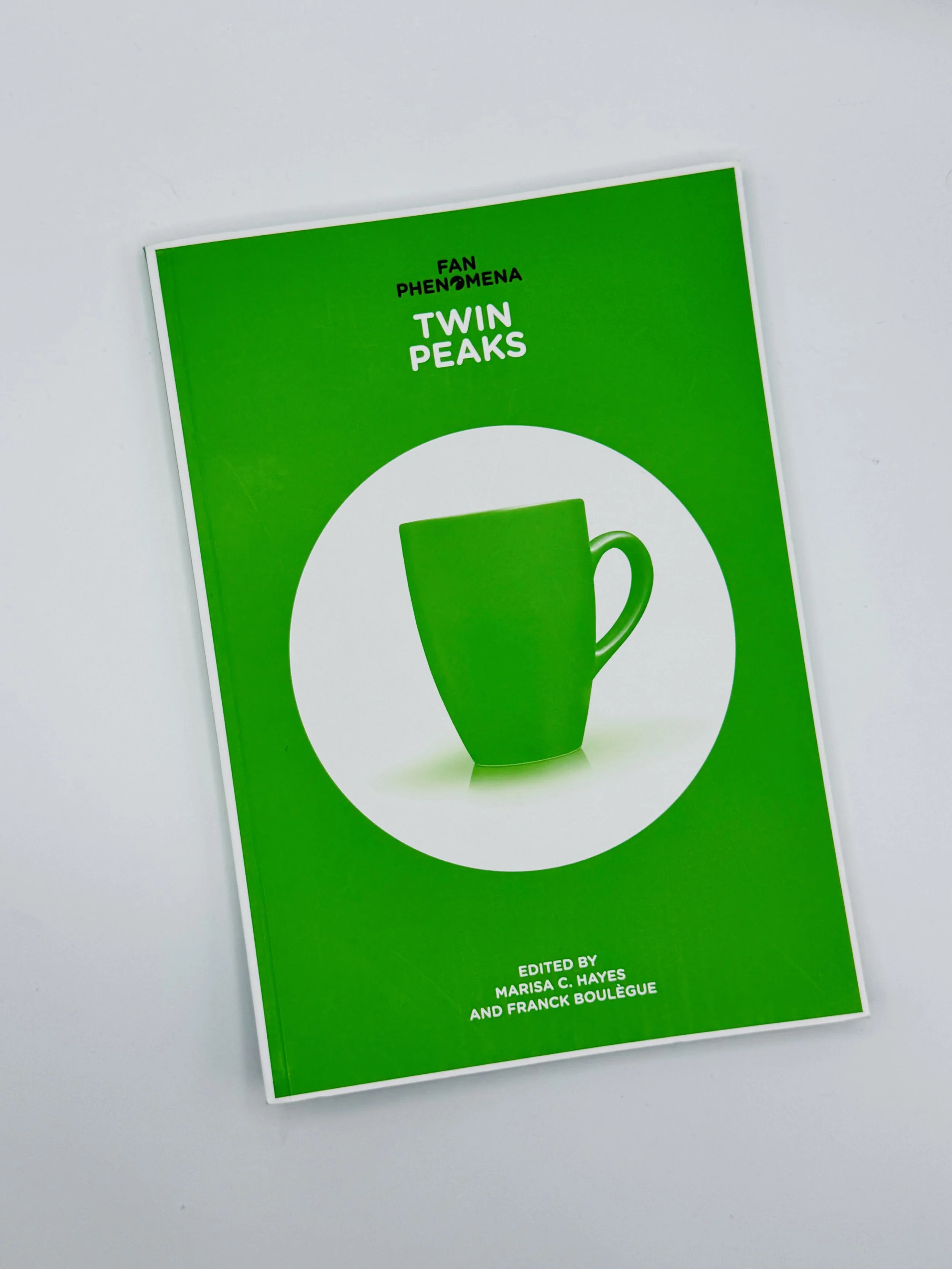
In 2012, we received an email from Marisa C. Hayes and Franck Boulègue, two European intellectual writers, asking us to compose an essay about a topic in Twin Peaks for a compilation book entitled Fan Phenomenon: Twin Peaks (2013). Scott and I wrote a piece titled ‘Yeah, But The Monkey Says, Judy’: A Critical Approach to Twin Peaks: Fire Walk With Me. It’s a banger essay that posits, among other key concepts, that the music of Twin Peaks is the only element of the art that never deceives the viewer. I’ve never read anyone else make such a simple and elegant argument for understanding the perplexing emotional journey of Twin Peaks. With this perspective, Scott and I gave viewers a rope to hold onto in quicksand that has held up for nearly 15 years. If art can yield universal laws that never change, this is one that Scott and I created together for Twin Peaks.
Years later, when music was all but removed from Twin Peaks: The Return, I returned to this joint supposition about how the music never lies, and it helped buoy my narrative analysis and appreciation for what happens over that perplexing 18-hour movie, which divided the audience into new segments. I remain proud of that essay and the company it keeps with other brilliant authors of that book.
But more importantly than pride, publishing a critical essay in a respected book of letters about a cultish popular form of commercial art gave us both more social proof. This new phase of outreach set The Red Room Podcast on a new path of growth and evolution, one that would be heavily focused on one show and one event no one expected—the return of Twin Peaks.
Scott and I hosted Marissa and Frank during Episode 61 in August 2013.
The Missing Pieces, a Blue Rose, & Twin Peaks Returns
In the first two full years of The Red Room Podcast’s production, 70% of our episodes were Scott and me volleying ideas back and forth about the shows and themes we loved. We discussed the TV shows we were watching and connected their themes to other shows and films. We introduced each other to new television and collected great shows to talk about, like little kids in the early 1980s who passed around Star Wars toys at the sandbox.
Here is a list of the TV shows and themes we discussed in the first phase of our podcast:
Twin Peaks
The Sopranos
Star Trek: The Next Generation
Battlestar Galactica
Curb Your Enthusiasm
True Blood
Six Feet Under
Deadwood
The Wire
Breaking Bad
Ricky Gervais
America In Primetime (PBS Documentary on TV)
Downton Abbey
Moonlighting
Revenge
Comedians In Cars Getting Coffee
The Newsroom
The Larry Sanders Show
The Films of Quentin Tarantino
Boardwalk Empire
Angel
True Detective
Soap
We also had several “list” shows where we compiled the best 20, 50, or 100 whatevers and went through them one by one. Those were my favorite shows because, while they focused on hyper-specific topics, they also covered a wide range of themes. No rules or time frames applied, though we tried to move through all of our lists as rapidly as possible to keep the conversation kinetic and compelling.
My favorite “List Shows” from this time were:
Top 50 Shows of All Time (December 2011)
Top TV Characters of All Time (May 2012)
Top 20 Feel-Good Moments on TV (October 2013)
Top 40 Shows You Should Watch (March 2014)
When guests were welcomed, they were usually other fans of the show under discussion. We didn’t have many critics or creators on during those first two years. The Red Room Podcast was a show created by fans of TV for fans of TV, and through all these changes, we held to that vision.
Act II: The Bridge Is Built Over Twin Peaks Falls (2014-2016)

2014 marked a significant transitional period for the Red Room Podcast, as it evolved from intimate conversations between Scott and me (and sometimes our spouses) into a roundtable guest format featuring interviews with other critics and commercial art creators. The data reveals the trend, but it doesn't explain why it happened. Regardless of the possible reasons, this shouldn’t change the fact that our show brought together smart, kind, and generous people who loved to consider and discuss great television and films. Four of these guests deserve mention in the context of this phase of The Red Room Podcast’s journey.
NUMBERS BREAK
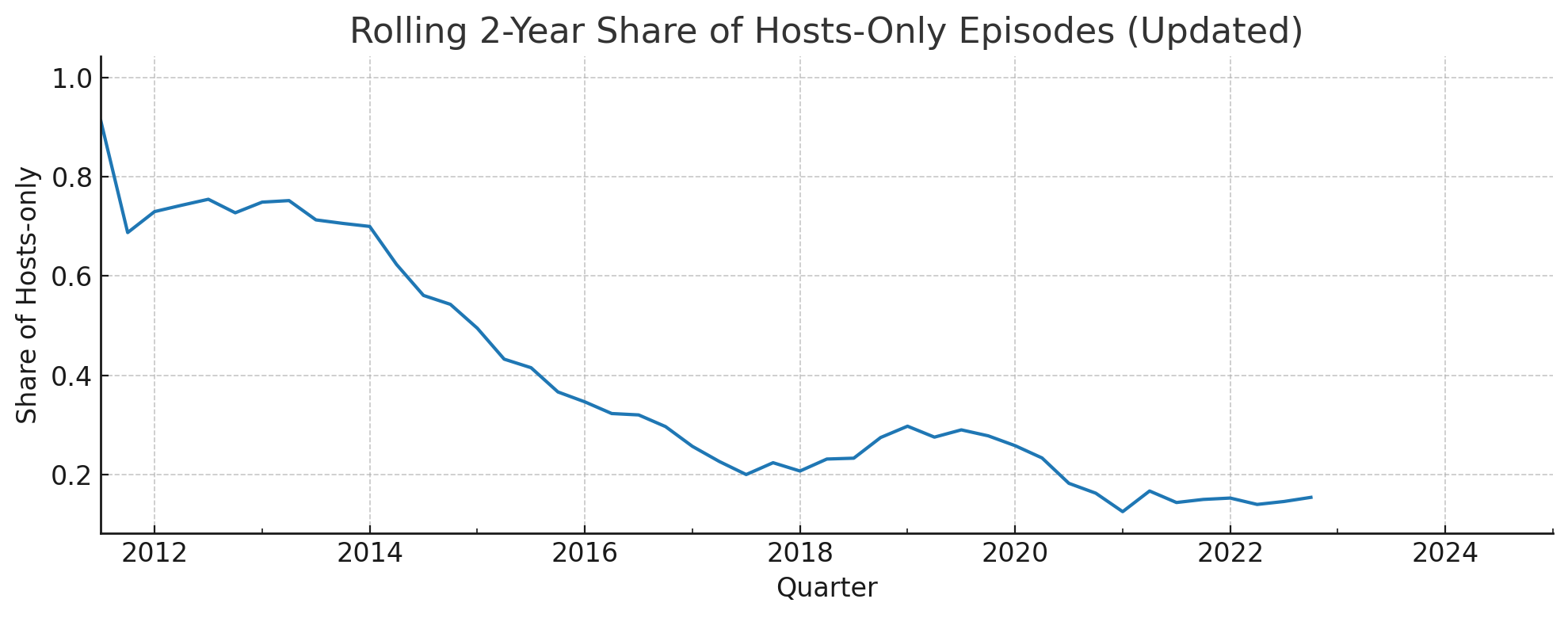
We observe the trend line for “Intimate” Red Room Podcast episodes, where Scott and I discussed themes and topics in a one-on-one setting, which declined in 2014 and never returned to Phase 1 volume.
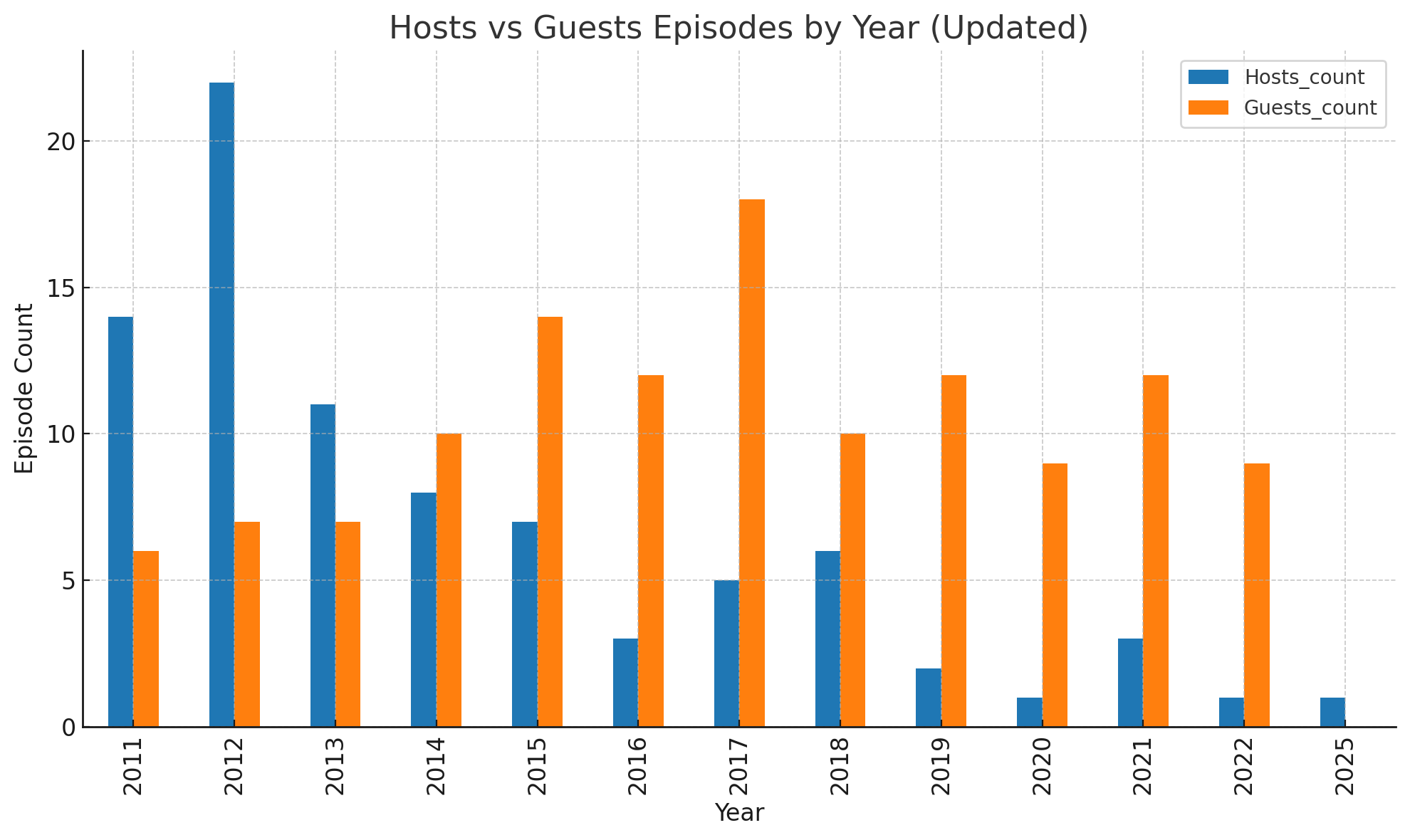
Two trends to note here are: 1) Note the rise in guest-focused episodes once 2014 arrived, with The Missing Pieces from Fire Walk With Me, Mark Frost’s Twin Peaks novel, and the announcement that Twin Peaks was returning. 2) Another factor to consider is the varying number of episodes published each year. For example, we produced half as many shows in 2013 as we did in 2012. **2025 data was an anomaly. The show ended in 2022.
Red Room Podcast VIPs
Four guests we welcomed on the show would prove pivotal to The Red Room Podcast’s journey: Courtenay Stallings, David Bushman, Brad Dukes, and John Thorne.
The four wonderful people were also responsible for the success of The Red Room Podcast.
VIP #1: Courtenay Stallings
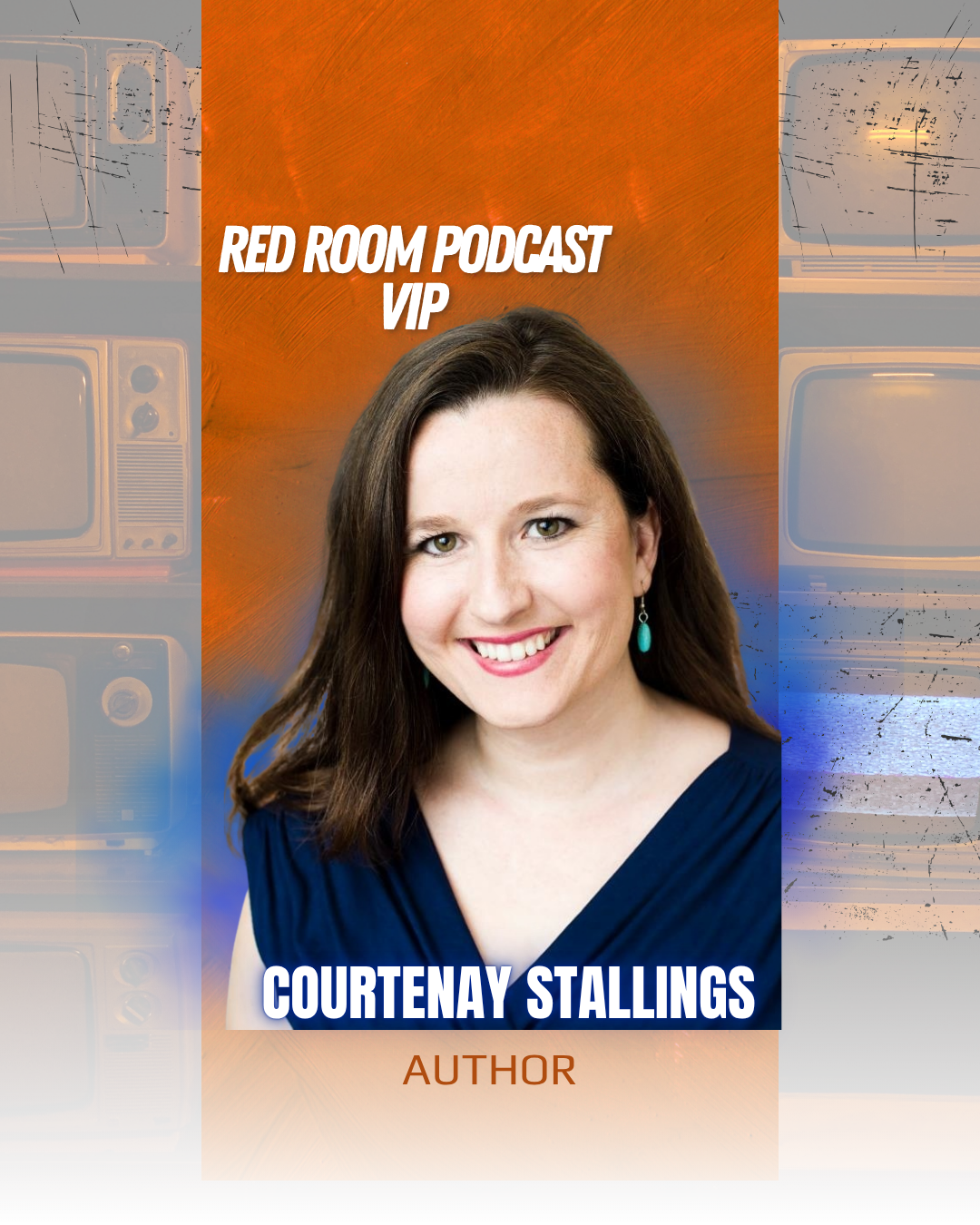
Courtenay is a brilliant and kind Professor who lives in California. In 2013, she was also a Red Room Podcast listener who was inspired to reach out and offer to be a guest correspondent when the University of Southern California hosted an intellectual event featuring most of the actors and creators of Twin Peaks. She made her debut appearance to report her findings (we also had a blog at the time, which didn’t last long) on Episode 61 in May 2013. We were overjoyed at the offer, and that marked the beginning of a long friendship and partnership with Courtenay. She would go on to become an essential part of the production team Scott put together for The Blue Rose Magazine, which he founded shortly after the announcement that Twin Peaks was returning.
VIP #2: David Bushman
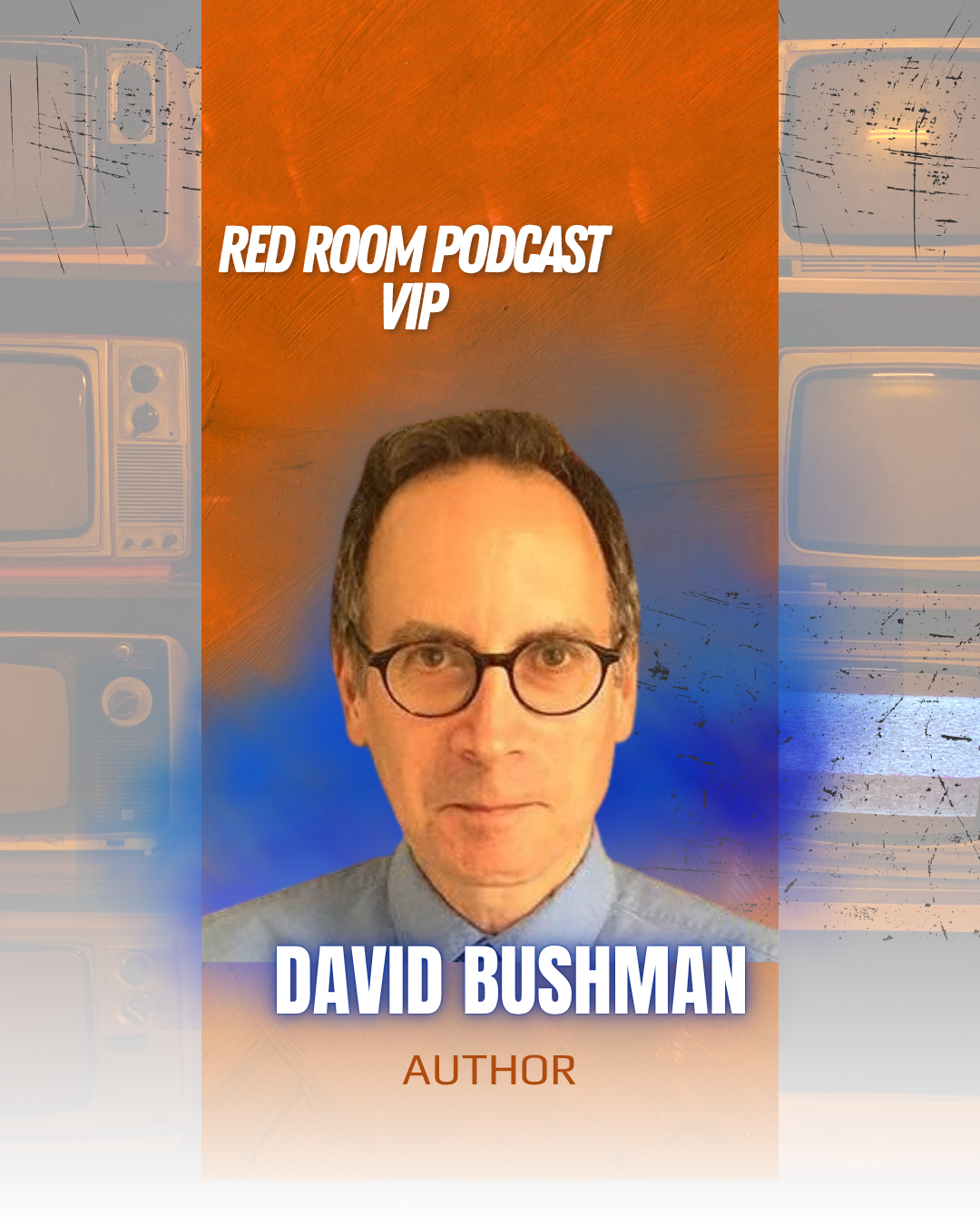
The Paley Center for Media is a nonprofit organization that preserves and provides access to a major television and radio archive, curating exhibits and public programs that focus on intellectual conversations about the cultural impact of media.
David Bushman was a curator for The Paley Center when we first invited him on the show for Episode 56 in March 2013. A fussy, opinionated, and argumentative old soul, I liked him instantly. But David and Scott developed a unique connection because they both see the world from a similar perspective. To me, they both sounded like the old men in the Muppet balcony, and I enjoyed participating in and witnessing their friendship begin and their partnership bloom over the years. After establishing two publishing companies together, Scott and David have produced incredible books about TV and Film, and I recommend browsing and buying directly from their website.
David was a guest on our show many times over the years, and his presence elevated the social proof and status of The Red Room Podcast. He graciously bestowed professional dignity on our work, and I am grateful for David’s contribution to the legacy of our show. But we've had many wonderful and compelling guests over the years, and I am thankful for all of them.
VIP #3: Brad Dukes
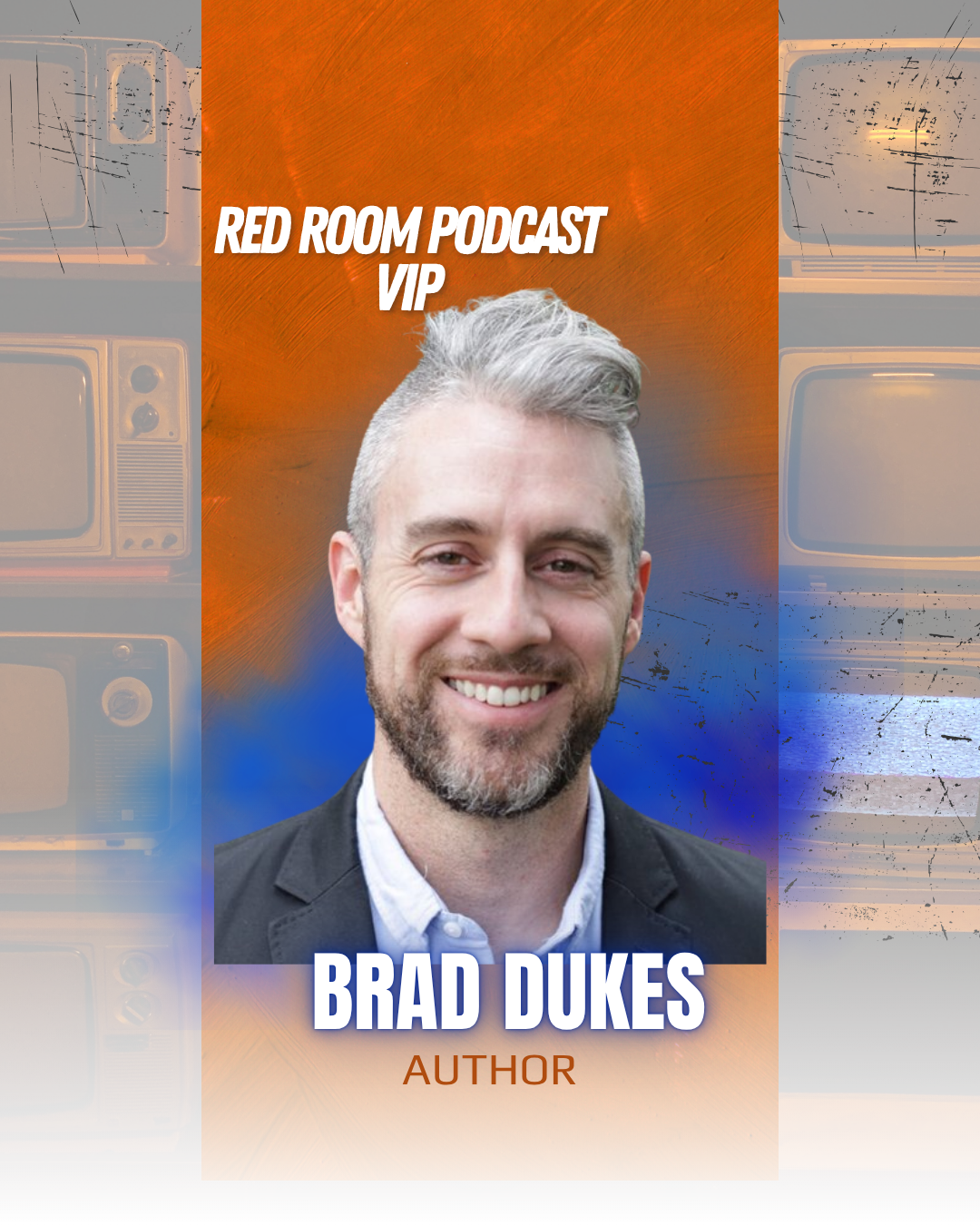
Another person pivotal in the journey of The Red Room Podcast was author Brad Dukes, who remains one of the luckiest writers I know, having published a book of oral history on Twin Peaks three months before the show was announced to be coming back. It was a hole-in-one swung at with an eye mask on. There was no planning it, but effort and opportunity lined up like the hand of an old-world god placing a champion on the game board of the Earth. Brad Dukes had the right book at the right time.
For a couple of years, Brad had been interviewing actors, producers, and the creators of Twin Peaks. At the point he started interviewing these semi-famous people about their old art, Twin Peaks had been a frozen franchise for over 20 years, and what Brad did was likely viewed by the creators at the time as nostalgic, necessary, and quaint. Brad was capturing the story behind the art, and it felt important to everyone. He researched, wrote, and got published one of the first great oral histories of important television. Brad’s book, Reflections: An Oral History of Twin Peaks, was a milestone moment, and while unprovable, I don’t believe Twin Peaks would have returned if it weren’t for Brad’s book and that USC event that Courtenay reported on for The Red Room Podcast.
Here’s my argument to support the above statement:
Ideas are memetic and reactionary, running on human emotion. Brad’s book, along with that USC event, brought together all those artists who created Twin Peaks, including Mark Frost and David Lynch. A lot of what-if ideas and emotions flowed through those creative people. At some point, Frost and Lynch discussed and agreed on a comeback idea. There was more story to tell in Twin Peaks, and it was time to shake up the world again. At some point, I speculate a team of nerd accountants at CBS reviewed the numbers and realized that the business plan was sound because Twin Peaks has a rabid fan base that consistently shows up and buys the experience repeatedly.
Brad Dukes was a guest on our show on June 10th, 2014, two weeks before his book was published. I think we even joked on the show about Twin Peaks coming back. But just over three months later, on October 3rd, 2014, at 11:30 AM Eastern Standard Time, the two creators of Twin Peaks simultaneously published the same message on their independent Twitter accounts. The simple message clearly indicated that something wicked good was on the way. The creators spoke in unison using the language of Twin Peaks, and it was a message to lovers of the art.
“That gum you like is going to come back in style.”
These Twin Tweets happened on October 3, 2014, at 11:30 AM EST from David Lynch and Mark Frost.
The formal announcement of Twin Peaks’ return (including planned format and airing timeline) followed on October 6th, 2014, again at 11:30 AM EST. Season 3 of Twin Peaks was announced to air on Showtime.
I can’t convey to you in words the wave of excitement that went through the community of Twin Peaks fans who had kept the show alive through festivals and friends groups for twenty-five years. The fans are still out there today, gathering forces and deploying small armies of art lovers across the United States and England to celebrate what they love together.
Additionally, on July 16, 2014, a massive restoration and expansion project was completed for David Lynch’s 1992 film, Twin Peaks: Fire Walk With Me. Nearly two hours of restored footage, dubbed “The Missing Pieces,” were released on Blu-ray along with a pristine upgrade in picture and sound quality. This gave us all plenty to talk about on The Red Room Podcast in the months leading up to the filming and the years of production of Twin Peaks: The Return.
VIP #4: John Thorne
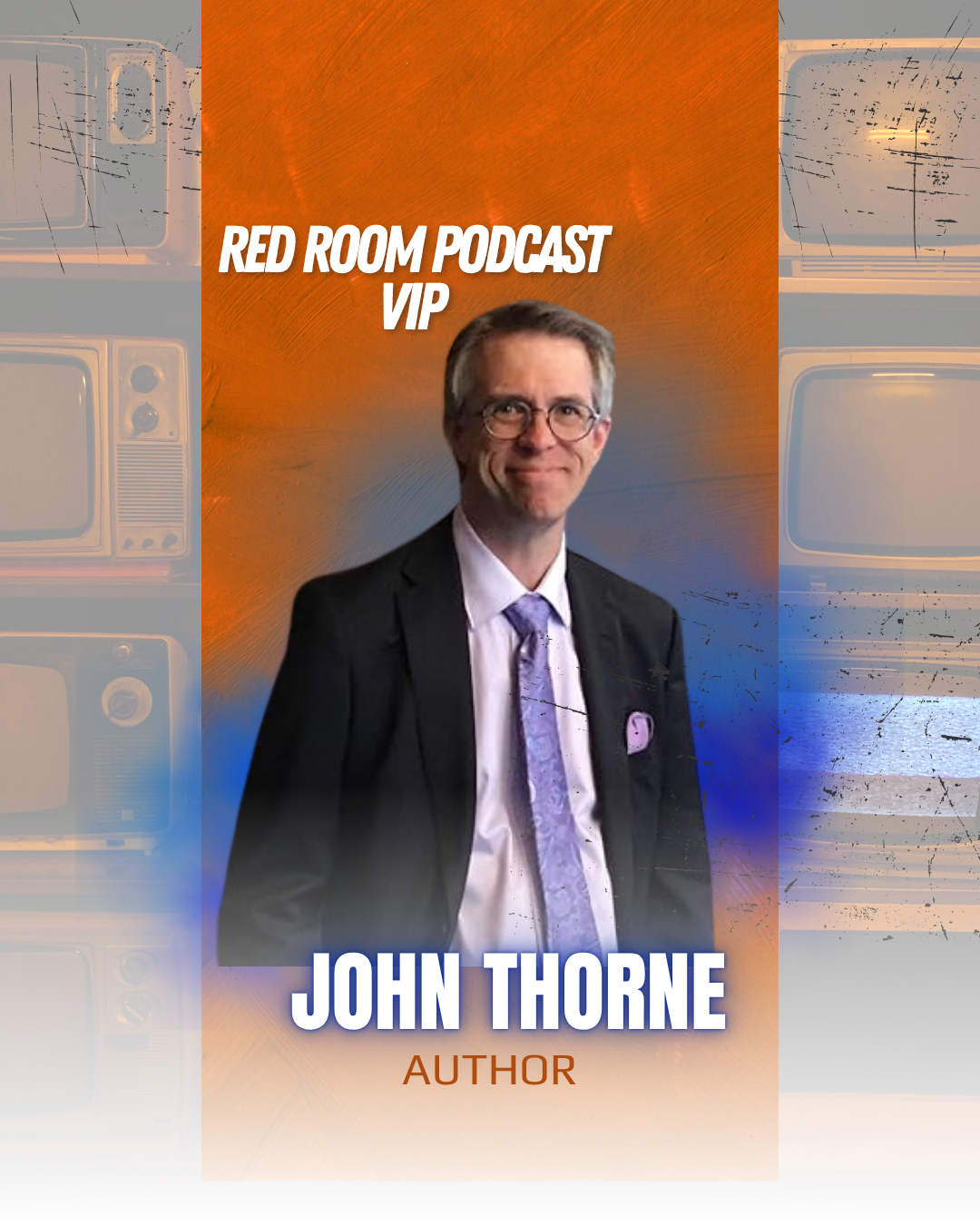
From 1992 to 2005, co-creator of the definitive Twin Peaks magazine Wrapped In Plastic, John Thorne, along with his now-deceased publishing partner Craig Miller, published seventy-five issues of incredible interviews, photography, and illustrations, along with elegant and compelling thought work about Twin Peaks and David Lynch’s other art. This magazine, along with the Twin Peaks Festival and a few well-run community websites, such as Dugpa, Welcome to Twin Peaks, and the aforementioned Twin Peaks Archive, all played crucial roles in keeping Twin Peaks alive for twenty-five years.
An artistic community developed around a shared archive of social experiences, characterized by a cinematic vocabulary and rituals that were heartwarming, meaningful, and profoundly changed people’s lives by giving them a sense of belonging. This work of commercial art brought together tribes of lovable weirdos through song and cinema.
John Thorne first graced the Red Room in November 2014 to discuss Wrapped in Plastic’s legacy, along with Twin Peaks’s announced return.5 Two years later, John returned to our show to discuss Mark Frost’s exciting new masterpiece of a novel, The Secret History of Twin Peaks, just after it was published. John and Scott were among the first to realize that something was deliberately off in the book, almost mechanically askew. Things were not what they should be. Weird, obvious factoids were off and misaligned with the events of Twin Peaks Seasons 1, 2, and Fire Walk With Me. It was a great experience to be part of that insightful conversation and to realize what was about to come when this show hit the air.
So a new phase of The Red Room Podcast began in 2014, and we would primarily focus on Twin Peaks going forward, although there would be occasional compelling deviations. In my opinion, we stopped recording shows together because we both had other priorities. I had a new high-pressure sales job, and Scott was hosting other podcasts and writing an oral-history book (like Brad Duke’s on Twin Peaks) about the old show Thirtysomething. And his ability to secure interviews with creators was paying off. He went on to write several books in this oral-history format about the commercial art he grew up loving. And I was there to buy and get signed every book to support him and attend every event I could, because I have been committed to Scott’s success since I met him, and that will never change.
However, it wasn’t easy to let go of The Red Room Podcast’s legacy, because nothing great is easy to let go.
That brings us to Part 3…
Part Three "The Return"
Act I: What We Built (2011–2016)
I want to tell you what it felt like before it ended.
Before the divergence, before silence settled between two friends who used to talk about television for hours, without noticing the time, there was a Thursday night ritual. “TV night” is what we imaginatively called it. Two couches and a television, the occasional cherry pie, and donuts shared by people who enjoy each other’s company and arguing about whether The Sopranos or The Wire was the greater achievement in the history of the medium and why saying Rick Berman ruined Star Trek was a colossally stupid thing to say. And there was a lot of laughter, followed by kind ridicule. Scott Ryan kept insisting he was right about something he was clearly wrong about; I told him so and why, and we both enjoyed it immensely.
That's where this story begins. Not with a microphone. With a friendship.
Twin Peaks was always present in the Red Room Podcast feed, but in those early years, it was a signal, not a takeover. Twin Peaks was the topic of three episodes in 2011. One in 2012. Two in 2013. The show was part of our critical vocabulary without yet dominating it. Other topics, other shows, other arguments to have. And Twin Peaks was dead like a dead peckerhead. There was no way it was coming back, but it was still an essential reference point for what television drama could be and do to people who watched with serious intention to understand it and themselves a little more.

And Twin Peaks was also the origin of the show's name. I suggested it, but Scott accepted it as a valid sales pitch. He embraced it, likely because, in those days, anything presented within the context of Twin Peaks inspired Scott to act, either by making art or by making an argument about art. Twin Peaks was Scott's organizing mythology — the show that shaped his sense of what television could be and do. He had been dreaming about attending the Twin Peaks Festival in Snoqualmie, Washington, since before I knew him. He still has an advertisement from the early nineties in his collection.
There’s a valley on a mountain in Washington State, in a place that feels so big, it takes up two towns. The Snoqualmie and North Bend area of Washington State is home to the Snoqualmie Falls, featured and mythologized in Twin Peaks. There is also the RR Diner, which is about as close as art gets to religion when you bite into one of their pies while sitting in a booth that you saw in Twin Peaks. These were not just filming locations to Scott. They were sacred ground.
I came to the original Twin Peaks late, through Scott, and I appreciated it differently than he did. I respected it as a work of art. When I watched the first two seasons and the movie, Twin Peaks was 20 years old and never coming back. Twin Peaks coming back would have been like Michael Landon coming back to do Bonanza after Little House on the Prairie and Highway to Heaven.
Twin Peaks was an interesting historical relic when I first encountered it. But I was not about to get on an airplane and fly out to see where they filmed it. I thought that was really stupid, and I’m pretty sure I said that to Scott, because that’s how we related to one another, with respectful cruelty, which is Generation X’s “Language of Gentlemen.”
I didn’t understand Scott’s desire to attend this festival, but I tried to be a good friend and support him. Scott had a world inside him devoted to Twin Peaks; it was a fictional place that captured his imagination and his heart. He was overjoyed in those days to share his love of Twin Peaks with other people. I was one of the last groups of people he shepherded into the Twin Peaks experience, which was a whole wonderful production. It was part of who Scott was, and I accepted it, allowing myself to be moved and influenced by his passion for art. I shared my own passion for art with him in return. Sharing art that matters is one of the most valuable acts two friends can do for each other. It’s how strong culture is built, and Generation Xers, like Scott and me, were made for this moment. We had been collecting and talking crap about art our whole lives before we met.
We were made for that moment of podcasts, before it became a commercial enterprise, and the shows moved from TV to the Internet, then down the algorithms of Hell. But Scott and I have always seen the world in fundamentally different ways, and we are alien to one another in many of them. Early on, we navigated our nuances adeptly. Over time, the distinctions grew more pronounced and eventually became a challenging rift.
By 2016, our show had evolved significantly. Guests had arrived: critics, scholars, artists, the four VIPs I wrote about in Part Two, whose contributions elevated everything we were doing. The impact of the Red Room Podcast was spreading outward, bringing in new voices and building something that looked increasingly like a platform. Scott was the driving force. He selected the themes, secured the guests, and managed the production. I showed up with my homework done, offered occasional show ideas, had my list of talking points ready, and an alternate perspective I knew would make the conversation worth having. Our thing was still working. We were still, at our best, like Siskel and Ebert; two passionate, hard-headed people whose disagreements were the point of the show. But something was changing that I didn't yet have a name for.
The Twin Peaks Festival was still happening in Snoqualmie every summer. Scott started going annually when he sensed something was happening with Twin Peaks. I think he was one of the first people to feel the art coming back alive; that’s how sensitive I think Scott was to Twin Peaks. The community was gathering in the valley on the mountain, and Scott moved toward that community with the instinct of someone who had been waiting his whole life to belong to exactly this thing. I watched from a distance because I never felt fully part of the Twin Peaks community. Not because the community did anything wrong, but because my relationship with the art was always private (except for the podcast thing), always interior, and always more interested in what the work said about consciousness, mortality, and the possibility of personal transcendence than in the rituals of collective celebration. I’m not a ComicCon guy. I’m an Ebert. I sit alone in the dark with stories told by light, and I write about what the stories that break me open do to me and try to work out how I think the movies did it. This is my nature, and I have made my peace with it.
Scott's nature is different. He is a performer, a documentarian, a man who, when everyone in the room turns to look at him, becomes exactly what the moment requires from the group.
Both of those natures built the Red Room Podcast. Our early strength was being so different. But those differences wouldn't survive what came next. Twin Peaks: The Return was coming. We just didn't know yet that we would watch the same show in very different ways.
And Now, the Conclusion…
Act II: Hurt (2015–2017)
There is a thing that happens when a person you love is wounded, and you can see it clearly, and they cannot, or will not, and the wound is shaping everything around them, including the art they are consuming and the judgments they are making and the distance that is quietly opening between the two of you. Men who were boys in the 1980s don't say emotional things out loud to one another, authentically. You wait it out. You graciously make fun of each other and laugh it off. You hope the person finds their way back to themselves. Sometimes they do. Sometimes the wound becomes part of who they were meant to be, like the face that didn’t look right until it got that scar. Hopefully, the person you knew reorganizes around lessons from their trials. You grieve quietly what has changed, and you move on to the next change. Life doesn’t stop for our sorrows. And sometimes, we can make our sorrows funny for others by laughing at ourselves first. I learned that from Scott. But sometimes it’s impossible to laugh, and the traumas we go through leave us with nothing but a hole of despair. In those times, we must lean most heavily on the grace and support of family, friends, and neighbors.
I can only tell you what I perceived.
What I observed was this: Scott went to the Twin Peaks Festival with his video camera, and over the next few years, something that began as an act of love seemed to have shifted. That’s all I can say from my perspective, over six years of talking to the man about the same shows, movies, and music all the time, and still finding new things to talk about.
As I mentioned earlier, Scott had been dreaming about going to the Twin Peaks Festival long before I met him. The waterfall, the diner, the cast members who still showed up every summer to shake hands, tell stories, and sign things. The costume ball, the props, the trivia contest, and then all the podcasts about it. I was pleased to watch my friend flourish in this community from the sidelines of our show, which had nearly grown to the point of warranting press clearance. I think the Festival represented something essential to Scott about why art matters and what a community built around great art can become. When he finally made it to Snoqualmie, he brought the only tools he had ever trusted to capture the world: a camera and his wonderful, warped mind.
He filmed the whole thing because that is who Scott is. He is a documentarian by instinct, a visual storyteller who has always believed that the right way to honor an experience is to preserve it and share it with others. He edited the footage into a film titled Voyages to Twin Peaks and published it on Amazon Prime Video. This was Scott being fully and authentically himself, the same impulse that produced his independent films, his oral histories, his years of building something from nothing with nothing but discipline, a camera, and the nerve to point it at the world, press record, and give ‘em a show.
My perception is that the Twin Peaks Festival organizers at the time were not pleased with Scott’s antics. But I was not there. I cannot tell you exactly what was said or how the tension accumulated over time. That’s gossip and, more importantly, it ain’t my business, other than how it impacted my friend and creative partner.
In 2017, the most significant year in this festival's history, the year Twin Peaks: The Return was airing on Showtime, Scott was involved in a situation. It was public, and it seemed embarrassing and a bit cruel. Scott has dealt mercilessly with bullies his whole life. He knows what he’s doing. But it’s hard to recover from a public event of embarrassment. Unfortunately, I speak from experience. I remember hearing the story and thinking it was a big misunderstanding and that it caused a lot of unfortunate emotions.
I perceived that Scott came home hurt after that event. I had never encountered that level of heaviness coming from him. Typically, when something annoying or worse happened to Scott, he filed it under the category of “Scott Luck,” a uniquely ironic form of bad luck that makes other people laugh when he tells the stories. He wrote these hilarious short stories into a book and recorded himself reading them for a separate podcast. Those stories are still hysterical, and I was a supporting character in a couple of them. But Scott wasn’t laughing about this story, at least not with me, and this was back when we routinely discussed serious matters with honesty mixed with gentle cruelty.
Imagine being in that state of mind, when you’ve given so much to this community and were treated so poorly. You’re publishing the magazine about Twin Peaks while Twin Peaks is coming back. And there were still 6 more episodes of Twin Peaks: The Return coming. The final six episodes of that show unlocked a door inside my psyche that has never closed. I count watching that show before, during, and after its release as one of my top three peak art experiences. To say Scott and my viewing experiences during those final 6 episodes, which aired in the late Summer and early Fall of 2017, were different is an understatement. He carried different baggage than I did.
Let me tell you a quick story about some other Twin Peaks fans.
In September, 2015, Twin Peaks Season 3 was being filmed in the Snoqualmie area. Nobody knew much about it, except for the inevitable insiders who leaked information through privileged channels, which is how information has worked since before the invention of language. But we didn’t know what the show would be called. Nothing remains a secret in the age of the Internet, and the filming plans were leaked before filming began. The Twin Peaks “content creators” (i.e., the podcasters, essayists, and book writers) at the time interviewed one another. Some shows started getting actors before the NDAs were in place, and then some old-school critics got hip to podcasts as the new way to talk TV.
A tight set of the old guard has been in Twin Peaks fandom. These people have kept the torches lit through dark times in the art. They plumbed the depths of two seasons and a film together. I can’t imagine they weren’t sick of their own voices and the topic by the time The Return started filming. That’s a long time to keep the torch lit on anything. Sometimes, these old guards would travel somewhere together. Mostly it was the Festival. But this was a once-in-a-lifetime chance to travel to Snoqualmie and watch some of the new Twin Peaks being filmed. It was too much of a siren’s song.
One of those filming nights in Everett, Washington (where the actual Palmer House is located and where this particular scene was filmed), a group of the traveling old guard witnessed Sheryl Lee and Kyle MacLachlan film a scene where she screamed a heaven-piercing wail several times in the middle of the street outside her house, at night. I can’t imagine what it would have been like to watch that experience live. I would think it would pop up in dreams and side thoughts for the rest of my life. Who am I kidding? I have only watched the scene on screens, and it still pops up in my dreams and moments of runaway imagination and reflection. At least one fan was rumored to have filmed the scene and shared it with others who weren’t present during filming. Unfortunately, it turned out this would be the final scene for Twin Peaks forever. And those people who witnessed it, or watched it on an unfortunately shared video clip, would enter Twin Peaks: The Return knowing the scene was coming. I can’t imagine knowing wouldn’t have impacted their ability to appreciate that scene within the ideal experiential context, meaning you didn’t know it was coming.
Likewise, I can’t imagine what it would have been like to suffer a public insult like the one my friend endured. Like any functional community, there is a hierarchy within the Twin Peaks fandom; it’s part politics, part art, and mercy and justice, cruelty and spite all spin on a wheel through communities like that. Public shaming, while compelling to watch on screen, is anything but funny in real life. Not if you’re a good person. But imagine this art that you’ve loved, and which has now indirectly caused you suffering, directly hurts you. From my perspective, and based on my memory of our conversations at the time (not photographic by any means), Twin Peaks: The Return was about to break Scott Ryan’s heart by doing the one thing he didn’t want it to do, which was to fuck around with the ending of the Twin Peaks movie Fire Walk With Me (1992). I believe, at the time, the ending of Fire Walk With Me was sacred ground for Scott, ground not only disturbed by The Return, but desecrated.
Art does not arrive in a vacuum; it absorbs whatever baggage you bring. When John Thorne and I established our podcast about Twin Peaks: The Return, it was during the COVID lockdown. You can almost hear the COVID disaster happening in the silence between our words on that podcast. Our deep conversations on themes in The Return were borderline apocalyptic, because that’s what was happening in the world around us. Our first episode was on the theme of “Baggage”: the emotional and intellectual baggage we bring to the art, and the weight of what we pull away. I have thought a great deal about this topic of baggage in the years since, because the same eighteen hours of television produced two completely different experiences for two people who had spent years building a shared, critical language around the same show.
My impression is that Scott experienced the ending of Twin Peaks: The Return as a betrayal, while I experienced it as a revelation. And I do not believe that divergence was primarily about the show itself. I believe it was about where each of us was standing when it arrived. Everyone was watching the same new art at the same time, but we were not all responding to it the same way.
I watched it at home in my theater room, which we built in our basement two years before Covid. I was open to what the show was doing. I had no wounds and very lightweight baggage to bring to the viewing of the new Twin Peaks. In many ways, I was the greatest audience this show could have hoped for, and I was grateful for the experience. Apparently, I was in the minority because many others seemed to be struggling in near-misery with the challenging art. Read Brad Dukes' essay A Love Letter To Twin Peaks The Return (Blue Rose Magazine Issue #12) to understand how much others were experiencing the opposite of what I was experiencing.
When The Return began airing in May 2017, something happened to me that I was not prepared for and did not have adequate language to describe at the time. David Lynch and Mark Frost had not just made a new season of a beloved old television show. They had made something else entirely, an eighteen-hour film that operated by a completely different set of rules, demanding a completely different kind of attention, rewarding the viewer, not with answers, but with an experience of consciousness itself moving through grief, memory, and the irreducible strangeness of being alive. But not everyone saw it this way. It would take me years to write that sentence. It seemed a lot of people were complaining, and not the ones we invited on the podcast to talk about it. We actually ran a series of shows on the Red Room Podcast, featuring guests who discussed the new Twin Peaks episodes a day or two after each episode aired. We combined a couple of episodes, but our podcast is a time capsule of real-time reactions to the art. We met storyteller and graphic novel genius Jeff Lemire. He would offer to interview me about my book when it was published. He wrote the introduction, and I’m eternally grateful for that deep kindness. We put our time into Twin Peaks: The Return. I never heard Scott complain publicly. I will not comment on what was said to me privately over that late Summer and early Fall.
But while others were complaining in their message board threads and text chains, Scott and I worked on different projects. He was actively publishing The Blue Rose Magazine and writing several other books. As for what happened that Summer, Scott had seemed to move on through that same mechanism that has served him well his entire life: he works hard on projects he cares about, then forgets them to move on to the next. There is a certain wisdom in this, a faith in kinetic motion, which I have found both inspiring and frustrating when dealing with Scott over the years. He’s often hard on the people around him, while cracking jokes about himself. After a while, that’s got to take its toll, especially when the art you love, the art you’re working so hard to emphasize and expand, feels like it turned on you and started spinning against the way you've always driven towards it. I don’t know many people who can outwork Scott. Examine what he’s been involved in producing over the past decade, and most people couldn’t have done it in a lifetime. Sometimes, the work we have to do is internal, inside our hearts, and cannot be expressed through any number of projects. Trauma is somatic, meaning it’s stored in the body. Until the mind processes and releases trauma first, the body keeps score.
For my part, I became more reclusive, spending more alone time in my theater watching and thinking about Twin Peaks: The Return. I started taking notes, jotting down times and numbers to keep track of my thoughts and the connections between the mundane and the important things happening in and around that show, and within the culture of that tenuous, hot summer, a new age for cruelty in America that seems tame by today’s standards. Gradually, I started writing and researching. The notes and numbers became the icons, graphs, design, and argument of A Skeleton Key to Twin Peaks, a book I would revise twice before I felt I had said what I needed to say and was still coming up with more. But before that book could become what it needed to be, the research took me in an unexpected direction.
In 2006, David Lynch wrote a book called Catching the Big Fish. It is a slim, quiet, deceptively simple book about creativity, consciousness, and the practice of Transcendental Meditation, which Lynch had practiced daily for decades and credits as the method connecting him to the creative source of everything he has ever made that matters. I read that book during the period when I was most deeply immersed in my analysis of The Return, and something in it stopped me in my tracks. I needed to learn and cultivate a Transcendental Meditation practice. There was no equivocation. It was as obvious as seeing the sun rise and calling it by name. So, I learned TM and had few expectations other than showing up for myself twice a day on good days, closing my eyes, and allowing my petty, flimsy consciousness, peppered with holes of anger and anxiety, to directly connect with an experience so blissful and easy that it would be outlawed by people who manipulate others to stay in power, if they were intelligent enough to know what it does.
I want to be precise about what happened next because it is easy to oversell something like this, and I have no interest in doing that in this forum, though I am an evangelist for everyone learning TM. What happened after I started meditating consistently every day was not dramatic like a psychedelic drug experience. It was gradual, and cumulative, and it changed me in ways I am still discovering. The anger and anxiety I had been carrying for years, longer than I had fully acknowledged, longer than I had admitted even to myself, began to settle. Not disappear. Settle. Like sediment dropping slowly to the bottom of water that has been agitated for so long. I forgot how clear the experience of being alive could be when I wasn’t carrying all that baggage around in the life I was living outside of my work with Twin Peaks.
Over the years of daily practice, my physiology has changed; it’s less volatile. Stress doesn’t affect me as deeply, and it doesn’t stick around as long. Things that used to be hard come more naturally as I have felt myself become a little bit calmer each year, more patient, more genuinely present to the people and the world around me. That doesn’t mean I’ve gone soft. I’ll jerk a knot in someone’s tail because I’m a naturally grumpy GenXer, but through TM, my sensitivity to art has deepened in ways I hadn't anticipated, not because I was thinking harder about it, but because I was carrying less noise into the experience. When you are quieter inside, the art gets louder.
The things Lynch, Frost & team were doing in The Return- the long silences, the unresolved images and storylines, the willingness to let a scene breathe past the point of comfort- began to feel less like provocation and more like instructions to me. The show was teaching the viewer how to witness it effectively. And TM had taught me, without my fully realizing it, how to be still enough to receive that instruction, to give the show the space to speak over years of witnessing and writing about what I saw and felt. My writing required deeper perception than trying to solve a puzzle or make connections. I can hear it in my head when I go back and read the early drafts of A Skeleton Key versus the later ones. The first edition worked hard to be smart, while the second edition just listened and wrote; that is the only way I know how to describe the difference.
My podcast work with John Thorne for the In Our House Now: An Inquiry into Twin Peaks: The Return and my deeper experiences over several TM weekend retreats and learning the advanced meditation techniques eventually led me somewhere I hadn't anticipated: to the Vedic Science of Consciousness, as interpreted by the founder of TM, the late Maharishi Mahesh Yogi. Through his interpretation of the ancient Vedic framework for all 7 states of Consciousness, I started to understand what The Return was doing at the deepest level I could identify.
I have delivered three major Twin Peaks projects over eight years, all of which can be traced back to those eighteen hours, all of which were made possible because I was open when the art arrived. I mourn that Scott wasn't, that he didn’t get to experience what I did, for whatever reason. But Scott has always been on his own journey, and I still honor his experience with the art as his own. I want to say that carefully because I am not claiming that his response to The Return was wrong and mine was right. Art is not a test with right or wrong answers. But I know what it looks like when a person encounters a great work from behind a wall of hurt and disappointment, and I know what gets lost when that happens. The work becomes a mirror of the wound rather than a window into something larger. Challenging or difficult work can easily be taken as evidence of bad faith. Strangeness, perceived for its own sake, can become evidence of contempt for the audience. Artists and intellectuals who make something genuinely new often get accused of destroying what was beloved, when what actually happens is that the beloved thing grows into something its own creators couldn't fully predict or control.
Twin Peaks: The Return is the most demanding work of art I have ever encountered in a commercial medium. It asks you to surrender the familiar version of what you loved and, in return (pun intended), offers you something stranger and more honest, something that may require more of you than you’re willing to give. That surrender requires a particular kind of openness. It requires arriving without too much to protect. Well, Scott had something to protect. Most of his publishing company’s commercial projects were focused on Twin Peaks. As a business owner, I understand risk now better than I did then. The joy of the Twin Peaks Festival, the fan community, and the identity he had been carefully building around his relationship with Twin Peaks had possibly been damaged in the cruelest possible way by the very people who ran the event he had dreamed about attending since before I knew him. Who could blame him if Scott came to the end of The Return with his defenses up? I understand how a person in that situation might feel betrayed by what the art was doing to its source material. I am one of the few people who understand how long and hard Scott Ryan worked for Twin Peaks, before and after that experience at the Twin Peaks Festival.
I wish I could have found a way to reach him across that distance in 2017. I'm not sure I tried hard enough. I had my own work to do, and it was just as intense. We were still making Red Room Podcast episodes together, still publishing, still Siskel and Ebert to the outside world. But the two steering wheels were pulling in dramatically different directions for the first time, and I felt it without knowing how to name it. I let the podcast's momentum carry us forward in relative silence instead of stopping to ask what was actually happening between us and anticipating how it would impact the show. That is my part in what came next.
The Red Room Podcast had always run on the energy of two people who disagreed in good faith. What I didn't understand until later is that good faith requires a certain amount of safety, and I don’t think Scott felt safe anymore in this business he had chosen. He may have perceived enemies where there were supposed to be friends. Some influential people in the Twin Peaks community had closed the door on his metaphorical foot. To cap it off, the art he loved had changed beyond what he could accept. They messed with the end of Fire Walk With Me. They took away Laura’s angel. And his partner in the conversation, the Ebert to his Siskel, was having a nearly religious experience with the same material that was breaking his heart.
We kept talking for a while, but we were no longer, in the way that mattered, in the same room.
Act III: After (2018–2022)
There was no dramatic ending to the Red Room Podcast. No final argument. No door slammed. No moment I can point to and say, there, that is where it broke. What happened was quieter, more ordinary, and, in some ways, harder to grieve because of it. The show simply became something different from what it had been, then nothing at all, and Scott and I became two people who share a family but rarely share a conversation anymore. That is how most relationships in the real world work, not with a dramatic scene but with a drift into silence, like continents moving over centuries after the collapse of a tectonic shelf. Of all things, technology killed the Red Room Podcast. The podcast platform we chose long ago to host our episodes was shutting down, and we had about 2 weeks' notice to download all our shows before the RSS links broke permanently. You can find the shell of our show on iTunes, see the episodes, and read what few reviews we captured. But when you click to play any of the episodes, you’ll get the same error. Not found.
Scott called me to say he was glad the episodes wouldn’t be available anymore, and he wanted to “let it die.” I suspect he didn’t want the internet to find out just how amateurish we were when we started the journey that led us to the end of our little project. Maybe he wasn’t proud of how far we’d come in our work together. What we accomplished together made it possible for us to do what we did apart from working together. But by 2018, the data told a story neither of us was saying out loud. The intimate episodes, the ones that were just Scott and me, the two nobodies disagreeing productively about television in front of the uncaring, merciless Internet, those conversations had declined and never recovered.
The guest format had taken over. Scott had nearly become the talk show host he always wanted to be: the frontman, the “Johnny Carson of Twin Peaks.” Scott’s work had become more about interviews with actors, directors, and creators, and Scott was very good at those interviews. Better than good. He’s one of the best. He has a gift for putting people at ease, for finding the human story within the professional story, for being the kind of host guests want to talk to. He can disappear from a conversation after he starts it. The oral history format suited him perfectly. He had been practicing it, in one form or another, since the days of his computer “Old Bessy,” and the indie Curb Your Enthusiasm episodes he wrote on paper and filmed in people's living rooms and guerrilla-style in public places like the Cajun restaurant he nearly got us thrown out of during one of his filming episodes.
Scott became, in those years, something he had always wanted to be: a platform, a presence, a recognizable figure in the worlds of the art he loved. The Blue Rose Magazine. The Fayetteville Mafia Press and Tucker DS books. The interviews with the people who had actually made Twin Peaks, Thirtysomething, and David Letterman, and the other shows that had shaped his sense of what television could be. Scott built that business from nothing, with discipline, nerve, and the same performer's instinct that has always been his greatest asset. He built a body of work that will outlast the podcast that preceded it. I want to say that without qualification, because it is true and because Scott deserves to have it said by someone who watched him do it from close enough to know what it cost along the way.
But the Red Room Podcast was not built to be a platform. It was built to be a conversation. That difference matters. A platform has a host and guests, and a direction of travel for information and insight, moving from the person who knows, over the cyberwall, to the audience that wants to know. A conversation, by contrast, has two people who are cautiously certain, committed to thinking something through together, and willing to be genuinely changed by what the other person says. The best episodes of the Red Room Podcast, in its early years, were simple conversations on a theme or topic. You could hear us thinking. You could hear the moment when one of us said something that surprised the other, and the other had to recalibrate, and what came out of that recalibration was better than what either of us had walked in with. That format requires two people who are willing to be wrong together in public. It requires the friction of genuine disagreement and the safety of genuine respect. It requires, in other words, exactly what Scott and I had built over Thursday nights across couches in Ohio, and exactly what had been quietly eroding since the summer of 2017.
Our show did not end because we fought. It ended because what made it worth making had already changed, and we were both too committed to our independent work and, perhaps, too careful with each other to name it out loud. In the end, stubborn respect killed the Red Room Podcast.
By 2022, our show had produced 211 episodes over eleven years. We tried hard to make each of them good. Scott's interviews in the final period are some of his best work. But they were his work. The two steering wheels had long since resolved into one, and I had quietly stepped out of the vehicle and started walking in a different direction. Neither of us made an issue of it because there was nothing to argue about. We were always different people, but we simply became different minds who could no longer meet in the middle. By then, I had become something I did not have a name for when we started. The research, the writing, and the daily practice of sitting quietly with my own mind had produced a state of mind interested in a very specific question: not what does this art mean, but what does art make possible? What does a great work of art do to the person who takes it seriously, as more than entertainment, more than a cheap, commercialized version of religion? How does proper art change the way we move through the world as people? How does effective art make us feel more alive, be more conscious actors, more capable of being present to the people around us? Surely, that’s how we live a life with depth and meaning, one scrawled in the handwriting of friendships, love, respect, and gratitude.
A Skeleton Key to Twin Peaks was my first attempt to answer that question. In Our House Now with John Thorne was my second. That show was everything the Red Room Podcast had lost. Twenty episodes of two genuine, trusting thinkers sitting and speaking about the most challenging art we had encountered at that point in our lives. I found it the most difficult and rewarding work of critical thinking and analysis I was capable of at the time, all of it growing from the same eighteen hours that Scott seemed to experience as a cheap betrayal. I’ve thought about our asymmetry of experience more times than I can count. I have turned it over in my mind, the way you keep trying to place the same puzzle piece because it looks like it fits, or like something you found on the ground that you can't quite identify, though it looks familiar while you examine it from different angles, testing its weight, wondering what it was before it became what it is now. And what I keep coming back to is not judgment but empathy and sorrow.
Scott introduced me to Twin Peaks. He sat me down on my own couch to make me watch it when I didn’t really want to. He did not accept my initial resistance. He pushed through that, and he was right not to accept it, because Twin Peaks became one of the most important works of art in my life. Exploring the art of Twin Peaks led me to a practice of self-care, which allowed me to cultivate a depth of perception about living (and art) I could not have experienced any other way. I owe Scott nothing but gratitude and best wishes. But I would be remiss if I didn’t convey my empathy that the person who gave me that gift of this art did not get to receive it himself when Twin Peaks returned. I imagine Scott arriving at the threshold of the final episode of Twin Peaks: The Return carrying wounds that closed the door before he could walk through it. And I was on the other side of that door, in a room full of bright light like Audrey in The Return, not fully understanding, for a long time, why he wasn't there with me. Writing this essay was part of that understanding. I think I see things from Scott’s eyes a little more clearly now than I did back then, which is what thinking about something important for a long time will do to a thinker. After thinking, then writing about it is what a writer does. So here we are.
The loss I grieve is not the podcast. That was a learning project that had as many failures as successes. I don’t regret a single one.
It’s not the platform, or the format, or the episode count.
It isn’t even the Thursday TV nights we’ll likely never share again.
I miss the conversations about The Return that we never found our way into together to meet in the middle. At some point, this “Twin Peaks Community,” in the sense of people “out there” who weren’t sitting next to each other in front of our microphone, became this monolithic new lens through which we had to engage with the art, if we were going to engage at all. I went along with it for a while, but it felt phony, performative, and superficial compared to the experiences I was having with the art in my theater at home, watching, thinking, and then writing about it. This is the curse of all intellectuals who are also introverts. Thankfully, we aren’t all born to be talk show hosts.
The simple truth, as I see it, is that our experiences of Twin Peaks: The Return had become volatile, like matter and antimatter. Our disparate experiences could not exist together in the same conversation about Twin Peaks. And eventually, we just stopped talking altogether. So it goes. Siskel and Ebert disagreed about hundreds of films across twenty-two years of sitting in the same room. But they were always in the same room. That was the whole point. When Siskel died, Ebert said he hadn't known until then how much of his own thinking had been shaped by having someone brilliant and stubborn to argue against, someone who was now gone from his life.
I know what he meant.
The Red Room Podcast is still out there. The conversations exist. Most of the 211 episodes are recoverable, salvaged from the digital equivalent of a barn fire and preserved for anyone who wants to go back and return. Breaking with Scott about the show’s historical value, I encourage you to go back and listen to two nobodies make a try for something great. And we kept it free. We didn’t charge a nickel for our work. It’s as close as either of us will get to impactful public charity, which is another plague of our Generation X; we don’t give much because we didn’t get much. The conversations we had about The Sopranos, Battlestar Galactica, True Detective, Breaking Bad, Mad Men, Bob Dylan, Quentin Tarantino, and so much more worked because we each maintained our unique perspectives while allowing the other the intellectual and moral space to make their argument for art. The list shows like “The 50 Greatest TV Shows of All Time” and “Greatest TV Couples” were deep conversations in which Scott and I revealed our ethics, morals, sentiments, hopes, dreams, and fears. Now that I’ve written that, I can see where Scott is coming from when he suggested we let the show die.
Art waits for us. Art is patient in a generous way that time is not. But art does not come to us, regardless of what the marketers say. We have to go to art and approach it with gentle humility, lest we waste our time and lose our souls in shallow reflection. One cannot follow a great work of art into the territory it is trying to open if they are too hurt to walk through the front door.
The episodes that worked did so because we brought our full passion and attention. The best of them were good because we tapped into the magic of bohemian appreciation for the art that mattered to us, and the episodes that missed were likely because we weren't both involved. The Red Room Podcast was produced by two people who cared about the work, about each other, and about the possibility that popular art could be taken seriously by people with no credentials, no platform, and nothing to offer except the quality of our attention and the discipline to do something dumb but still worth doing. That was always enough for me. It still is. I’m proud of the Red Room Podcast. And I’m proud of all my co-creator has accomplished since I’ve known him, which is going on twenty years. I hope he’s proud of me. I wish him the very best of happiness in this life, and that is the biggest insult one can offer Scott Ryan. It’s my pleasure to offer such a flagrant insult to a friend like Scott Ryan. We did great work together once. Now that I’ve told this story, I regret nothing, and I’m grateful for everything.
We talked hard.