Miranda Sound’s Western Reserve at 20 Years Old: “Time Travelers Stuck In Time”
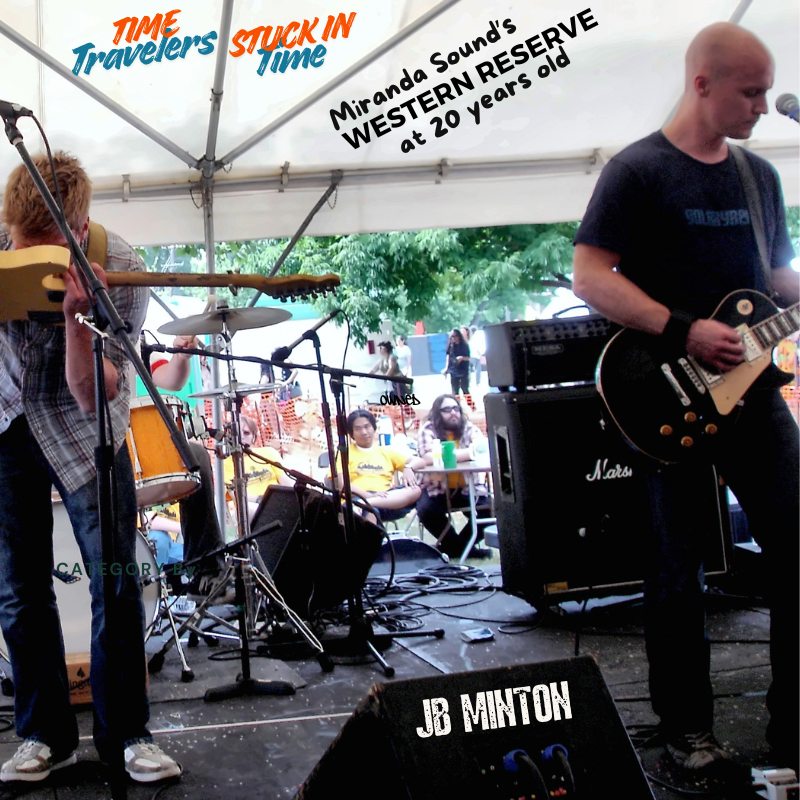
Author’s Photo – Comfest 2007 - Columbus, Ohio – Dan Gerken sings into his Telecaster while Billy Peake, Dan Bell (hand), and Sean Sefcik (off-camera) hold the line. The alchemy of this band onstage always evoked awe, wonder, and deep enjoyment in those of us lucky to be in the audience wherever they performed.
Evasive Mental Stratagem
In the Fall of 2005, four musicians drove from Columbus, Ohio, in the center of the state, to a studio in Baltimore, Maryland, to finish making an album nobody knew the world needed. The world of 2006 was not yet the kind of place that needed to hear the album Western Reserve. The record arrived, earned a handful of smart reviews in the indie press, found a real, if modest, audience, and within three years the band members returned to focus on careers, families, and the often unglamorous responsibilities of adult life offstage and outside the studio. What nobody understood at the time, what Miranda Sound themselves almost certainly did not understand, was that with Western Reserve, they had made an artistic and moral document for a future that hadn’t arrived yet, but was coming on fast.
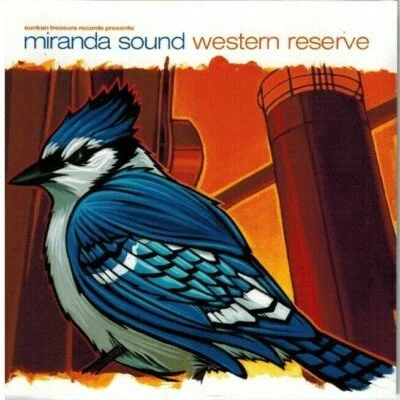
Artists:
Dan Gerken·Dan Bell· Sean Sefcik·Billy Peake
Produced By J. Robbins·Jon Chinn·Neal Schmitt
Mastering By T.J. Lipple at Silver Sonya and Inner Ear Studios
Recording Studios: Workbook Studio and The Magpie Cage
Released: June 13, 2006
12 songs, 36 minutes
©2006 Sunken Treasure Records [STR002]

Miranda Sound formed at Bowling Green State University as a three-piece, then relocated to Columbus at the turn of the century. Gradually, they built the configuration that would define their best work: a quartet with Billy Peake and Dan Gerken trading lead guitar and vocal duties across songs that moved fast and thought hard. Sean, Dan, Dan, and Billy. Four artists working together to deliver compelling experiences in sound and vision.
Dan Bell’s drumming on Western Reserve is the record’s engine. A song like “We’re Making Amends” requires the drums to be almost violent, while “My Surname’s an Airplane” needs something more measured, a steadiness that can hold the melody’s weight without collapsing under it. Bell was the band’s timekeeper, but time in his hands was never just a metronome; Miranda Sound’s percussion was a bumping, kinetic wave that the bass, guitars, keyboards, and voices could push through and jump around, but never hide behind.
Dan Gerken sings on this record like someone who had something valuable to say and a very limited time to say it. His vocal performances on Western Reserve are marked by an urgency that is never simply aesthetic; it comes from somewhere real, some actual pressure bearing down on and bleeding out his words. When he sings
Don’t you trust your indecision
You’re all washed out, no commitment
you believe he has either watched people make that mistake (or nearly made it himself) and knows what it costs. There is an element of Dan’s vocals on this record that still feels spontaneous, like he’s making up the words in the living moment. Listen to him on “Take It Where You Can Get It”:
Now I know that I’ve grown cold with age
But I started warm,
so it’s hard to notice the change.
That’s not singing as performance. That’s singing as confession.
Billy Peake is the flashpoint of the fire that fuels Miranda Sound. He has a voice that moves from tenderness to indictment without losing a thread. Where Gerken’s delivery leaned into urgency, Peake’s leaned into clarity. As a guitarist, Peake worked in counterpoint to Gerken, providing the melodic line that the other guitar could argue with or reinforce. Peake’s playing has a clarity that matches his voice: clean, deliberate, emotionally direct without being sentimental. He understood that the best way to make someone feel something is not to tell them what to feel but to describe the situation so precisely that the feeling becomes unavoidable.
Sean Sefcik was the band’s anchor. In a quartet built on dual vocalists and restless guitar arrangements, the bass carried an uncommon weight, not just a rhythmic foundation but a melodic argument from the middle perspective, the thing that held the center when the songs threatened to scatter. Sean worked very well in tight spaces, where restraint did more work than flash, providing the songs' structural logic. On Western Reserve, that logic is everywhere, the way the bass moves through “The Lull of Youngstown” like a surveyor’s line, marking territory for guitars to cross and a direction for vocals to burn their way through the field. Sean was not the loudest presence on the record, but he made it possible for everyone else to be heard.
The dual guitar arrangements on Western Reserve are never simply doubled; they’re a conversation, each player listening to what the other is doing and responding in real time. And the vocals and lyrics are an extension of that same conversation, a deep, philosophical inquiry on the nature of truth, justice, love, and duty. And all that is in addition to how great the music sounds, with its energy, drive, and mercy.
Critics who covered Miranda Sound gravitated toward particular phrasing, such as "smart, restless guitar-pop," and the characterization was apt, though it risked underselling the band's work. The restlessness wasn’t merely musical. It was moral. These were songs written by people who cared where they lived and about the well-being of those who lived beside them, who paid attention to what American civic life had promised and what it was actually delivering.
Miranda Sound didn’t typically play arenas, though they did play Lollapalooza in 2003. Their world was music festivals, clubs and bars like Little Brothers in Columbus’s Short North, The Basement beneath the A&R Bar, and other mid-market touring runs where the guarantee was small, and the crowds were attentive and passionate rather than large. The Columbus music scene of that era operated on a pre-social-media logic of community, reluctantly extended through the Internet, but also expressed through flyers, word of mouth, CD102.5’s on-air calendar, and a DIY ethic that treated promotion and friendship as essentially the same. Miranda Sound was a fixture in that world. They were not Columbus’s biggest band, but they may have been its most serious one.
For their third album, Western Reserve, Miranda Sound hired J. Robbins to produce, a choice that announced something about their ambitions. Robbins, known for his work with Jawbox, one of the more important bands to emerge from the Washington D.C. post-hardcore scene of the early 1990s, as well as bands like Burning Airlines and Government Issue, was a producer of records that held their shape under pressure, and lasted over time.
Robbins wasn’t the kind of collaborator you hired if you were content to make what you’d already made. The sessions moved between Workbook Studio in Columbus and The Magpie Cage in Baltimore, a two-city back-and-forth that lent the album a certain divided attention, music made by people who knew the places they came from but wanted to know more about the places they were going.
What came back from those sessions was the most fully realized thing the band had made. Twelve songs. Tight arrangements. A production that allowed the guitars to soar without letting them sprawl. This was not a record of space jams. It’s an album of bones, blood, and benevolence.
And lyrics, some of which now read like prophecy.
The Lull and the Pull
Start with “The Lull of Youngstown,” which opens the album’s emotional argument with a portrait of provincial stagnation so precise it functions as a kind of sociological field study:
There’s a potent time trap on the
eastern end of the Western Reserve
that you won’t spot in bold font on a map.
Hardly clever, but harshly committed
to papal trails and high school football
that keeps the old guard heavy in the gut.
This is not a song about nostalgia. It’s a song about what nostalgia costs, the slow gravitational pull of a world that has decided that it will never reconsider. The chorus frames the choice in terms that feel, twenty years on, more urgent now than they did then:
Don’t you trust your indecision.
You’re all washed out, no commitment.
No detail and no precision.
If you stay, you’ll always regret it.
The band knew something about what it cost to leave; they’d made that choice themselves, from Bowling Green to Columbus, and they were watching their generation make it, or refuse to make it, all around them. This chorus was a subconscious earworm that either inspired action or turning away from the mirror. But “The Lull of Youngstown” is not a simple anthem for departure; it’s not “Born to Run.” The song’s empathy runs deeper than its critique.
Farewell John Young, your town’s a disaster.
The best of us won’t dare to stay here.
We drained our savings and gassed our land yachts
And broke all ties with our high school sweethearts.
There is grief embedded in that last line that rivals anything John Hughes put on screen. It’s an emotional sentiment without contempt for the people left behind, a sentiment filled with sorrow about what leaving means. This album, and this song particularly, understands that the problem with identity is that it’s always shifting. There was once a time in the world when a young person could get into a car and drive away into a new life.
You’re Making a Mess
In 2006, the Iraq War was three years old and losing whatever public confidence had once propped it up, because lies always come back home. The Bush administration was navigating the disastrous aftermath of Katrina, where they abandoned people of color to suffer and die after one of the worst natural disasters on record. A Republican Congress was preparing to lose its majority, and the political culture was thick with recrimination and bad faith. There was a lot of negative mojo stirring itself into the shit storm we’re continuing to waft our way through twenty years later. Into this moment, Miranda Sound dropped two of the most pointed songs in their catalog.
“We’re Making Amends” is the rawest of the two, a thrashing political accusation that reads now with an uncomfortable familiarity:
He’s made the rules to suit the suits
with asinine intent.
Lionized the manic right
and left the left to fend
for ourselves again.
To take us back in time.
The song’s chorus…
You’re making a mess.
We’re making amends.
…operates as a kind of civic vow after recognition that those responsible broke something sacred in the public trust. It was a finger in a Boomer’s eye. But there is also an insistence in this song that repair is still possible, even obligatory. This is not a song of despair, but one of grievance channeled through responsibility and rage, reluctantly settling into social duty.
“To Partner and President” is more measured and, in some ways, more devastating. It is a song about accountability that refuses the easy catharsis of pure condemnation:
You have made a difference
but you are not forgiven
for squeezing blood from stone
so you can beautify your home.
The tension the song holds reflects a more sophisticated and nuanced political position than most rock songs attempt to convey, acknowledging complexity without excusing failure. It insists on consequence without abandoning the possibility of redemption.
I believe in modern science.
That line, delivered as a closing refrain, could have read in 2006 as a statement about the administration’s record on climate and public health. Twenty years later, it reads more like a declaration of faith with recognition that such declarations should not have to be made in the first place, a mark of how far we’ve fallen, and how far we now have to climb to get back to zero.
“Calculator for Words” extends the album’s political argument into something more intimate: a portrait of institutional bad faith that feels less like a song about elected officials than about any organization that has forgotten its founding purpose, including the institution of intimate human relationships:
You’ve been about as helpful as a calculator for words.
Multiplying adjectives and nouns, you get verbs.
When you finally press the equal sign, you blame the other.
You subtract the best of what we’ve made since the century turned.
It seems like prophecy when we consider, with our 2026 minds, that Generative Artificial Intelligence is indeed a probabilistic calculator for words that may or may not be ripping our souls from our bodies with every digital transaction. The imagery in this song is precise and withering: an intelligence deployed in service of nothing, producing noise that resembles meaning without generating any. And the emotional register of the song’s conclusion…
This is gonna break us up.
We did the calculation wrong.
…suggests that the cost of institutional failure is never merely political. Moral failure is personal and relational, and it will cleave the fabric of community trust if we do not mend it with the necessary collective effort. And I remind you, this song was created twenty years ago, making this whole record a potent time trap.
A Bedrock of Decency
What makes Western Reserve hold up more than a protest record of its time is that its politics are never divorced from its humanity. These songs remain calls to personal and social enlightenment. Miranda Sound was never the kind of band that traded in abstraction. Their songs were populated with specific human beings navigating particular predicaments suffering universally felt thoughts and feelings: the estranged son in “Jackson Milton,” the kid who nearly drowned, and the friend who nearly died in a car crash in “Close Calls,” and the narrator of “Take It Where You Can Get It” who has watched himself grow cold and cannot find his way back to warmth. Anyone who has lost a cherished friend or beloved pet understands this emotional experience firsthand.
That last song deserves particular attention.
It is, on its surface, a love song (or an anti-love song), and a meditation on the space between what someone needs and what they are able to receive. But its central recognition is larger than romance:
These past few years, I’ve been losing it
and there’s nothing to take its place,
except you, and you are strong as Hell,
but you can’t bear that weight.
This is the album’s emotional center: empathy for the suffering and frailty of others, while raging against the injustices of lives that are too short, too greedy, and often too shallow. The politics of Western Reserve burns bright and clear, but this song’s tone is quieter, a more frightening diagnosis: that warmth can be lost gradually, without your noticing, and that by the time you understand what has happened, it may be too late to recover or even apologize. Like dementia of the heart.
The album is, among other things, an argument for paying attention to that emotional drift, becoming sensitive to the heated but fading color of our love’s intensity. For recognizing, before it is too late, that the small daily choices about how we treat people and what we value are not separable from the large political questions about what kind of country and world we want to live in.
“The World Is Not a Stage” makes this argument most explicitly, its chorus a direct address to someone who has mistaken performance for substance:
Good lord, cut the camera. This is not a show.
The best things about you are the things you don’t know.
In 2026, with a media culture built almost entirely on performance and self-presentation, these lines feel prophetic and doom-filled. But they were not prophecy. These lyrics were observations and a warning. Miranda Sound was paying attention at a moment when attention was the one thing that might have made a difference for us all.
Time Travelers Stuck in Time
The phrase that keeps returning when I think about what Miranda Sound accomplished is: they were time travelers, stuck in time. Like the opposite of Billy Pilgrim in Slaughterhouse-Five. He came unstuck in time, rootless and uncentered. Miranda Sound was the opposite of that. They planted roots, and the plant has grown over these long and tortured two decades. You can listen to this now. Music doesn’t lie, and it never has, not even in the age when it's made mindlessly by computers. It’s not a lie if you feel it where it hurts most.
This band wrote music whose full meaning, outside a medium circle of friends, was not yet available at the cultural moment of its first reception. The songs of Western Reserve addressed a situation that was just beginning to take shape in 2006, a civic crisis of moral turpitude that would not fully reveal itself for another 20 years. The band shipped the message before the world had learned to read it. Good thing some of us still read both the language of music and the signs of the times.
Western Reserve was not primarily about the future, although anxiety about it was a factor. It was about the present moment, the specific, documented present of Ohio, in 2006, with its real place names and its real political frustrations and its real human beings making life decisions about whether to stay and fight or leave and mourn what they had to leave behind.
Who am I? Where am I going? This is what Tony Soprano rose from a coma to ask nobody in the final season of that show, but these are the only questions that matter, the only reasons to make art, share it, and then talk about it while smiling and laughing. Miranda Sound’s music is all about these two questions.
Western Reserve’s increasing relevance is not evidence of foresight, but rather precision, the kind that lands rocket ships on other planets. The kind that redirects the position of people’s souls. The band described the world so carefully that its description has continued to hold true as the world has changed, like a prism in the middle of rotating light.
There is also something to be said about what the band’s subsequent history teaches us. In 2008, Miranda Sound did not break up in any conventional sense. They went on hiatus, where members pursued careers and families, the ordinary physics of adult life pulling against the extraordinary demands of being a working band, and yet the musical partnership and friendships endured.
The bandmates continued to make music together and apart. The collaboration that had produced Western Reserve did not dissolve; it transformed. It went into a chrysalis to become more of its truest nature. A band has a communal Self at the center, and this is what must be protected and nourished in the service of great art.
The story of Miranda Sound and their Western Reserve album is its own kind of argument about what sustained commitment looks like and what it means to build something that outlasts the challenging conditions under which it was made. Every note this band played, every song it sang, every drumbeat and bass bump were in service of a commitment to the common good, with empathy for the pain of personal sacrifice and unreleased trauma.
The self-titled album that followed in 2008 was the band’s temporary farewell, but when the music still cranks fire, rock and roll farewells are rarely final and often outlive their human creators. What endures is the music; this is as it should be. The artifact, the document, the proof that a quartet of human beings with musically creative talents from Columbus, Ohio, spent a year making art that told the truth about where we lived, what we feared, and what we once believed it was still possible to become.
What Counts
In “Jackson Milton,” the album’s opener, the opening lyrics are two questions that have put burdens on my mind since I first heard them:
Are you happy?
Are you healthy?
What will matter when the moral accounting is finally done for each of us? The noise, performance, and calculus of self-interest, or the quieter, more durable things, like commitment to your happiness, and then committing to the happiness of others? After we’re all happy as honey pie, maybe we’ll start working on building something together that might outlast these challenging conditions that make building something to last so difficult.
Miranda Sound voted, with their music, for the durable things. They were a band that built a bedrock of moral decency and artistic excellence in the middle of a decade that was eroding the foundations of civil society as fast as the good artists and teachers could lay it down. And these old boys were right, not prophetically right, but humanly right, in the way that people are right when they pay attention and tell the truth and do not pretend that the world is better than it is or worse than it can become. And they pick up a guitar and sing us a song.
Twenty years later, Western Reserve waits for us to come along. It’s a potent time trap, revealing that the world has finally caught up with Miranda Sound's music and the band. If we’re lucky, our deep appreciation and affection for their art may awaken the stirring bear from its sleepy cave.
You are holding in your hands something that was made for exactly this moment, for you, by a band that had no way of knowing this moment was coming, but also couldn’t wait to get here.
Listen carefully. This is not a show.